What is spread betting and how does it work? Examples & UK tax rules

Spread betting lets you trade on financial price movements using leverage, meaning you can access markets without buying the underlying asset. Here is how it works and what you need to know before starting.
QUOTE
Risk comes from not knowing what you’re doing.
– Warren Buffett
– Warren Buffett
Please note that the information provided in this article applies specifically to the UK and Ireland markets.
Big ideas
- Spread betting is unique to the UK and Ireland, where profits are currently (as of 2025) exempt from Capital Gains Tax and Stamp Duty, unlike most other forms of trading.
- The spread in spread betting is simply the difference between the buy and sell price quoted by the broker, and it effectively replaces traditional commissions.
- Spread betting allows you to speculate on markets such as indices, currencies, shares, and commodities without owning the underlying asset, using leverage to control larger positions with a smaller deposit.
- Although the name betting lends itself to a comparison to gambling, spread betting is regulated in the UK by the Financial Conduct Authority (FCA), meaning firms must follow strict rules on client protection.
What is spread betting?
DEFINITION
Spread betting is a way of speculating on the price movement of financial markets without buying the actual asset. Instead of owning shares, commodities, indices or currencies, you place a spread bet on whether the price will rise or fall.
It is widely used in the UK and Ireland, where it is available through regulated providers and subject to specific tax treatment.
The core thing you need to appreciate is that a spread bet is a financial contract between you and the broker. You are NOT purchasing the underlying stock or index, but rather predicting the direction of its price movement.
The core thing you need to appreciate is that a spread bet is a financial contract between you and the broker. You are NOT purchasing the underlying stock or index, but rather predicting the direction of its price movement.
Just like any trade or investment you might choose to make, the outcome is binary – you win or you lose money. However, the amount you win or lose varies, and depends on the extent of the price movement.
- If the price moves in your favour, the profit is calculated based on how many points it shifts and the size of your stake per point.
- If the price moves against you, the same calculation applies to your loss.
Unlike fixed-odds gambling, financial spread betting works by mirroring actual market prices.
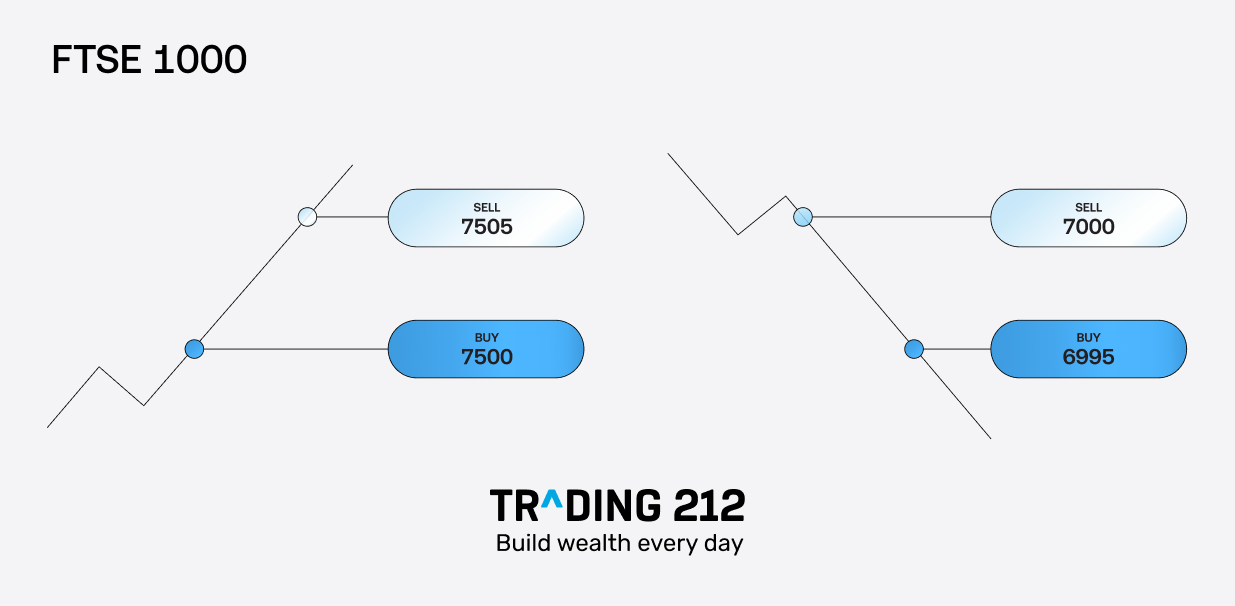
A spread betting account provides access to markets such as equities, foreign exchange, commodities and indices. The provider sets two prices: the buy and the sell level, with the gap between the two known as the spread. That spread is effectively the cost of placing a trade.
You can spread bet on whether the FTSE 100 will move higher or lower, or speculate on the pound, oil, gold, or even cryptocurrencies. The principle is the same: you decide whether to go long or short, choose your stake size, and your profit or loss depends on the number of points the market moves.
Spread betting trading is flexible in that it allows speculation on a wide variety of markets, but it is also complex.
Understanding the meaning of spreads, margins, and how positions are structured is key before deciding whether to use it.
A spread betting account provides access to markets such as equities, foreign exchange, commodities and indices. The provider sets two prices: the buy and the sell level, with the gap between the two known as the spread. That spread is effectively the cost of placing a trade.
You can spread bet on whether the FTSE 100 will move higher or lower, or speculate on the pound, oil, gold, or even cryptocurrencies. The principle is the same: you decide whether to go long or short, choose your stake size, and your profit or loss depends on the number of points the market moves.
Spread betting trading is flexible in that it allows speculation on a wide variety of markets, but it is also complex.
Understanding the meaning of spreads, margins, and how positions are structured is key before deciding whether to use it.
What is a spread betting account?
A spread betting account is your gateway to placing spread bets. Like any traditional trading account, you need an intermediary to access the markets, known as a broker. In this case it is a spread betting broker.
Unlike a traditional share dealing account, where you buy and sell the actual asset, a spread betting account is designed for speculating on price movements without ownership. It is sometimes referred to as a spread bet account or spread bet trading account.
When you open an account with a provider, you will go through a registration process that looks a bit like this:
Unlike a traditional share dealing account, where you buy and sell the actual asset, a spread betting account is designed for speculating on price movements without ownership. It is sometimes referred to as a spread bet account or spread bet trading account.
When you open an account with a provider, you will go through a registration process that looks a bit like this:
- Identity checks and a short assessment of your trading knowledge (because spread betting is a leveraged activity, and providers are required by UK regulation to ensure clients understand the risks)
- The account gets approved
- You can fund the account
- Choose from a wide range of markets to trade such as shares, indices, forex, commodities, and even cryptocurrencies.
The account layout is more or less like any online trading platform or trading app. It usually shows the buy price and the sell price for each market, with the difference being the spread. You then select whether you want to buy (go long) or sell (go short), decide on your stake per point, and confirm the trade.
How does spread betting work?
Spread betting works by allowing you to speculate on whether the price of a financial instrument will rise or fall, without taking ownership of the underlying asset.
As mentioned already, instead of buying a share, a currency pair, or a commodity, you decide if the market price will move up or down from its current level. Your profit or loss depends on how far the market moves in the direction you chose, multiplied by your stake per point.
As mentioned already, instead of buying a share, a currency pair, or a commodity, you decide if the market price will move up or down from its current level. Your profit or loss depends on how far the market moves in the direction you chose, multiplied by your stake per point.
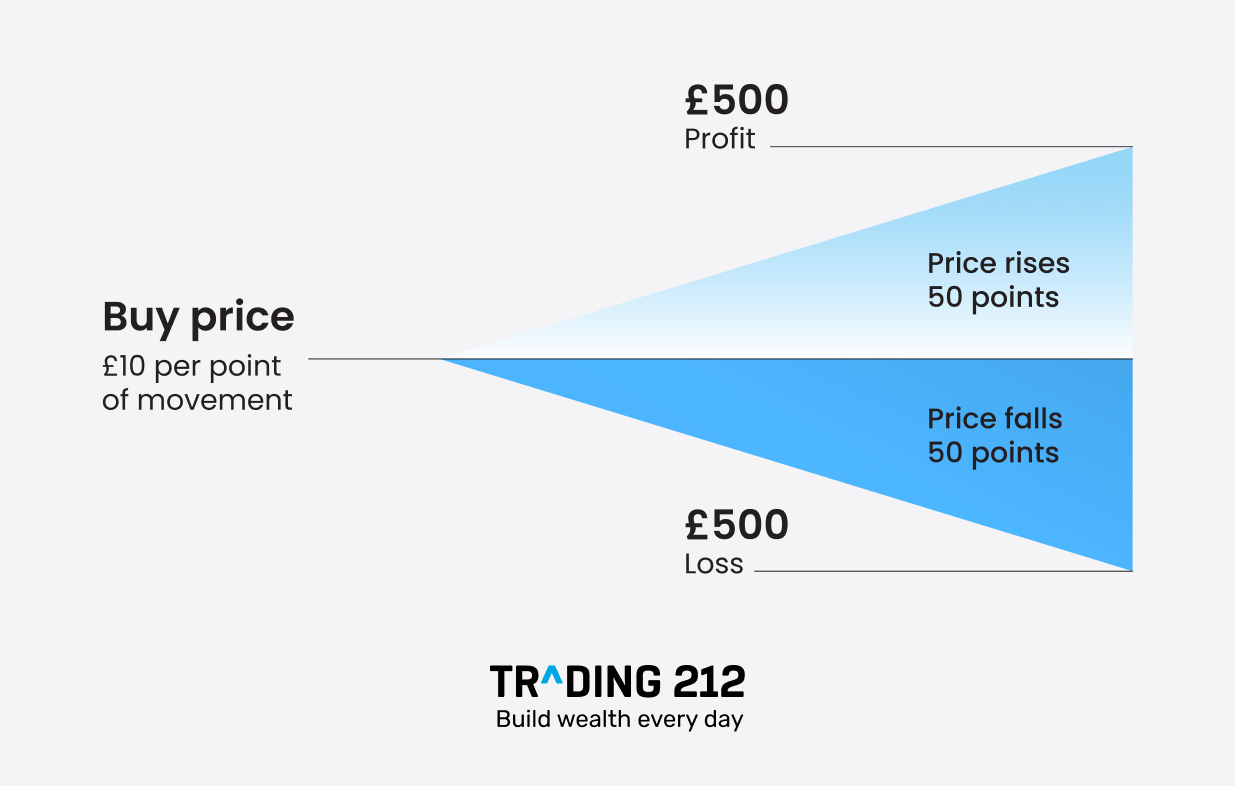
EXAMPLE
You open a spread bet on a stock at a quoted buy price of 200p.
You think the price will rise so you buy at that level, at £10 per point.
• If the price increases to 250p and you close the position, you make 50 points × £10 = £500 profit.
• If the price falls instead to 150p, the same calculation works in reverse, and you would lose £500.
NOTE: This is a simplified example to demonstrate P&L without consideration of the bid-ask spread mentioned above.
You think the price will rise so you buy at that level, at £10 per point.
• If the price increases to 250p and you close the position, you make 50 points × £10 = £500 profit.
• If the price falls instead to 150p, the same calculation works in reverse, and you would lose £500.
NOTE: This is a simplified example to demonstrate P&L without consideration of the bid-ask spread mentioned above.
The concept applies across markets. In forex spread betting, you might place a trade on GBP/USD, while in index spread betting you could speculate on the FTSE 100 or Dow Jones. Commodities such as oil and gold, or even cryptocurrencies, follow the same principle.
The structure is straightforward once you understand it: choose your market, decide your direction (long or short), select your stake size, and place the trade. Don’t worry, it usually takes a little while (and some practice in a demo account) before the concepts really sink in!
The structure is straightforward once you understand it: choose your market, decide your direction (long or short), select your stake size, and place the trade. Don’t worry, it usually takes a little while (and some practice in a demo account) before the concepts really sink in!
What is the spread in spread betting?
DEFINITION
The spread in spread betting is more accurately referred to as the bid-ask spread. It is the difference between the buy price and the sell price quoted by the broker.
It is this gap that gives spread betting its name, and it represents the cost of opening a position. Rather than paying a fixed commission fee, the spread is how the provider charges for offering access to the market.
EXAMPLE
A stock is quoted at 100p in the underlying market.
A spread betting company might show a price of 99p to sell and 101p to buy.
That two-point difference is the spread.
A spread betting company might show a price of 99p to sell and 101p to buy.
That two-point difference is the spread.
The way it works is that when you open a position, you immediately start with a small loss equal to the spread. The market has to move beyond that gap in your favour before you can make a profit.

The chart above illustrates this point.
- At 9:00, the market price is quoted with a buy (ask) level at 51 and a sell (bid) level just below at 50.
- When you buy at the ask, your entry point is slightly higher than the actual midpoint price. As the market rises, you can later sell at the bid, which is still below the ask.
- By the time the position is closed at 9:30, the price movement has covered the cost of the spread, leaving a two-point profit.
This structure is common across all financial spread betting markets, whether you are looking at forex, commodities, indices or individual shares.
Tighter spreads are usually seen in heavily traded (or highly liquid) instruments such as major currency pairs, while more volatile or less liquid assets, like certain cryptocurrencies or small-cap shares, may have wider spreads.
Tighter spreads are usually seen in heavily traded (or highly liquid) instruments such as major currency pairs, while more volatile or less liquid assets, like certain cryptocurrencies or small-cap shares, may have wider spreads.
What spread levels are typical in trading?
The size of the spread in spread betting varies depending on the market, the level of liquidity, and the volatility at the time.
In general, more heavily traded instruments such as major currency pairs or large stock indices tend to have tighter spreads, while less liquid or more volatile assets will have wider ones.
For example, in forex spread betting the spread on GBP/USD or EUR/USD can often be less than one point (often called a pip in forex trading) under normal trading conditions. In contrast, more exotic currency pairs may have spreads of several points because they are traded less frequently. Similarly, index spread betting on the FTSE 100 or S&P 500 might show spreads of just a few points, while lesser known indices which lower average daily trading volumes could have wider spreads.
NOTE: When spread betting on shares, the spread level usually reflects both the underlying market spread and an additional amount set by the provider.
However, there are other costs to consider such as financing charges for holding positions overnight that can impact which type of trading account type will be overall more cost-effective. For example, it might be possible to earn a swap when forex trading a currency pair, whereas overnight financing charges on the same pair when spread betting might result in a charge.
In general, more heavily traded instruments such as major currency pairs or large stock indices tend to have tighter spreads, while less liquid or more volatile assets will have wider ones.
For example, in forex spread betting the spread on GBP/USD or EUR/USD can often be less than one point (often called a pip in forex trading) under normal trading conditions. In contrast, more exotic currency pairs may have spreads of several points because they are traded less frequently. Similarly, index spread betting on the FTSE 100 or S&P 500 might show spreads of just a few points, while lesser known indices which lower average daily trading volumes could have wider spreads.
NOTE: When spread betting on shares, the spread level usually reflects both the underlying market spread and an additional amount set by the provider.
However, there are other costs to consider such as financing charges for holding positions overnight that can impact which type of trading account type will be overall more cost-effective. For example, it might be possible to earn a swap when forex trading a currency pair, whereas overnight financing charges on the same pair when spread betting might result in a charge.
How to spread bet in the UK (5 Steps)
Spread betting in the UK follows a fairly straightforward process, but it involves several steps that are important to understand before placing a live trade. Because spread betting is a leveraged product regulated by the Financial Conduct Authority (FCA), providers must follow certain procedures to ensure clients know the risks involved.
1. Open a spread betting account
The first step is to register with a UK-authorised spread betting company. During the application you’ll usually provide proof of identity and answer a short questionnaire to assess your knowledge of leveraged trading. This is part of regulatory requirements, designed to confirm that you understand concepts such as margin and leverage.
2. Fund your account
Once approved, you can add funds. The money in your account acts as the base for covering margin and potential losses. While providers may allow you to start with a relatively small deposit, it is important to commit only what you can afford to risk, even though UK brokers offer negative balance protection. This means you can’t lose more money than you have in your account.
3. Select your market
A typical spread betting platform in the UK will offer thousands of markets. These range from UK and international shares to indices such as the FTSE 100, commodities like oil and gold, and forex pairs including GBP/USD. Some platforms also provide spread betting on cryptocurrencies and bonds. Choosing your market is largely a question of interest, liquidity, and the size of spreads.
4. Place your trade
After selecting a market, you decide whether to buy (go long) or sell (go short), set your stake per point, and add a stop loss if you wish. For example, if you believe the FTSE 100 will rise, you buy at the quoted buy price. Your profit or loss depends on how far the index moves relative to your entry level, multiplied by your chosen stake.
5. Monitor and close
Once open, your position will fluctuate with the market. You can close it at any time or leave it to be automatically closed by a stop loss or take-profit order. Overnight funding charges apply to rolling bets, which is another factor to monitor.
The advantages of spread betting
Why would you actually bother with spread betting when you can just as easily use any traditional brokerage account for trading? The two big ones are the way costs are structured, the tax treatment in the UK, and also the variety of markets available.
1. No commissions
A clear benefit of spread betting - and also CFDs for that matter - is that you don’t usually pay a commission to place a trade.
Instead, the cost is built into the spread between the buy and sell price. Entering and exiting a trade at these levels means the cost of the spread is automatically factored in.
This can be more cost-efficient than paying a flat commission on each trade, especially for smaller position sizes.
Some spread betting brokers offer the opportunity, sometimes as a premium client option, to trade on a lower or sometimes raw spread with flat commissions. This is usually preferable for those with larger account sizes.
Instead, the cost is built into the spread between the buy and sell price. Entering and exiting a trade at these levels means the cost of the spread is automatically factored in.
This can be more cost-efficient than paying a flat commission on each trade, especially for smaller position sizes.
Some spread betting brokers offer the opportunity, sometimes as a premium client option, to trade on a lower or sometimes raw spread with flat commissions. This is usually preferable for those with larger account sizes.
2. Tax benefits
Profits made from spread bets are generally exempt from Capital Gains Tax and Stamp Duty, unlike traditional share dealing where both may apply.
For many retail traders, this makes spread betting an appealing alternative to buying shares outright, especially for short term trading strategies.
NOTE: This tax-free status applies only in the UK and Ireland, and is subject to change if government rules are updated.
It is important to note that while profits are not taxed, losses can't be offset against other taxable income. This is a clear difference from CFDs or traditional investing, where losses can sometimes be used to reduce tax liabilities.
For many retail traders, this makes spread betting an appealing alternative to buying shares outright, especially for short term trading strategies.
NOTE: This tax-free status applies only in the UK and Ireland, and is subject to change if government rules are updated.
It is important to note that while profits are not taxed, losses can't be offset against other taxable income. This is a clear difference from CFDs or traditional investing, where losses can sometimes be used to reduce tax liabilities.
3. Variety of markets
From the perspective of time spent opening and maintaining financial accounts, it is arguably preferable to use a single spread betting platform that provides exposure to thousands of instruments – all from one place, rather than opening separate accounts for shares, forex, or commodities.
For UK traders, this means being able to spread bet on shares listed in London as well as international markets in the US, Europe, and Asia. Indices such as the FTSE 100, S&P 500 and DAX are widely available, alongside popular commodities like oil, gold and silver. Currencies remain a core part of spread betting too, with major forex pairs often quoted at very tight spreads. Some providers also offer access to cryptocurrencies, government bonds, and interest rate markets.
With Exchange Traded Funds (ETFs) on all kinds of markets now ubiquitous, the variety of markets accessible from a standard stock trading account are now much wider than they used to be, making this benefit less than it used to be.
For UK traders, this means being able to spread bet on shares listed in London as well as international markets in the US, Europe, and Asia. Indices such as the FTSE 100, S&P 500 and DAX are widely available, alongside popular commodities like oil, gold and silver. Currencies remain a core part of spread betting too, with major forex pairs often quoted at very tight spreads. Some providers also offer access to cryptocurrencies, government bonds, and interest rate markets.
With Exchange Traded Funds (ETFs) on all kinds of markets now ubiquitous, the variety of markets accessible from a standard stock trading account are now much wider than they used to be, making this benefit less than it used to be.
Disadvantages of spread betting
Spread betting has certain limitations and risks that are important to understand before trading. These largely stem from the way leverage, spreads, and costs interact with market movements.
1. Misuse of leverage
Because spread betting uses margin, traders are exposed to the full market movement while only committing a fraction of the value as a deposit. This means even a modest price shift can have a disproportionately large impact. While this magnifies potential profits, it equally amplifies losses, which can quickly deplete your available funds if not managed carefully.
2. Risk of margin calls and automatic position closure
While UK investors benefit from negative balance protection, your positions can still be closed automatically if losses approach your available margin. This is known as a margin call. It can lock in losses and prevent further trading until additional funds are deposited. Managing margin levels carefully is therefore essential.
3. Complexity for beginners
Spread betting can appear straightforward at first, but the combination of leverage, margin, and costs makes it more complex than traditional share dealing. Understanding these elements is vital before opening a live account.
Spread betting vs CFDs: Differences and similarities
Spread betting and Contracts for Difference (CFDs) are often mentioned together because they share many similarities. Both allow you to speculate on the movement of markets without owning the underlying asset, both are leveraged products, and both are widely offered in the UK by regulated providers. Despite this, there are some important distinctions that influence how each product is used.
The main difference for UK traders lies in tax treatment. Profits from spread betting are currently free from Capital Gains Tax and Stamp Duty, while CFD profits are taxable and must be declared. However, CFD losses can be offset against tax, which is not the case with spread betting.
Another difference is how trades are structured. In spread betting, you stake a certain amount per point of market movement. In CFD trading, you are trading contracts that directly mirror the size of the underlying market exposure.
There are also differences in who tends to use each product because spread betting is entirely a retail product specific to the UK and Ireland, while CFDs are more widely used internationally.
The main difference for UK traders lies in tax treatment. Profits from spread betting are currently free from Capital Gains Tax and Stamp Duty, while CFD profits are taxable and must be declared. However, CFD losses can be offset against tax, which is not the case with spread betting.
Another difference is how trades are structured. In spread betting, you stake a certain amount per point of market movement. In CFD trading, you are trading contracts that directly mirror the size of the underlying market exposure.
There are also differences in who tends to use each product because spread betting is entirely a retail product specific to the UK and Ireland, while CFDs are more widely used internationally.
Forex trading vs spread betting
Forex trading and forex spread betting are often confused because both involve speculating on the movement of currency pairs. In practice, the underlying idea is the same — you are looking to profit from changes in exchange rates, but the way the two are structured is different.
Contract size vs stake per point
- In traditional forex trading, positions are quoted in lots or contract sizes (for example, one standard lot equals 100,000 units of the base currency). Profit and loss is measured in pips, with each pip having a set monetary value depending on the lot size.
- In forex spread betting, there are no contracts in lots. Instead, you choose a stake per point (or pip) of movement. If you bet £2 per point and the pair moves 20 points in your favour, you make £40. The same move against you results in a £40 loss.
Tax treatment in the UK
For UK residents, forex spread betting is currently free from Capital Gains Tax and Stamp Duty. By contrast, profits from trading forex via a standard account are taxable and must be declared.
Advantages of spread betting over traditional trading
Compared with traditional share dealing, spread betting offers certain advantages that make it stand out as a trading method in the UK above and beyond the pros mentioned above.
Trade in up and down markets
In traditional share dealing, you buy shares and hope the price rises. If it falls, you can only wait or sell at a loss. Spread betting works differently.
You can take a long position if you expect the market to rise, or a short position if you expect it to fall. Both actions are carried out in the same account with the same process. This ability to speculate in either direction gives spread betting an added layer of flexibility, particularly in volatile markets or during downturns when traditional investors may find fewer opportunities.
You can take a long position if you expect the market to rise, or a short position if you expect it to fall. Both actions are carried out in the same account with the same process. This ability to speculate in either direction gives spread betting an added layer of flexibility, particularly in volatile markets or during downturns when traditional investors may find fewer opportunities.
Leverage and capital efficiency
Instead of paying the full cost of a trade, you place a fraction of the value as a deposit. For example, a £10,000 equivalent position might require only £500 in margin if the requirement is 5%.
This is beneficial to those who don’t have the funds available to trade high share prices or larger contract sizes. It also allows access to larger trades with a smaller starting outlay compared with buying shares outright.
Leverage, however, is a double-edged sword. While it increases capital efficiency and can magnify profits, it also magnifies losses.
This is beneficial to those who don’t have the funds available to trade high share prices or larger contract sizes. It also allows access to larger trades with a smaller starting outlay compared with buying shares outright.
Leverage, however, is a double-edged sword. While it increases capital efficiency and can magnify profits, it also magnifies losses.
Market and instrument selection
Choosing which markets to trade is a key part of spread betting, and the decision often depends on a mix of:
- Personal interest
- Trading style
- Practical considerations
One factor is location. UK traders often start with familiar markets such as the FTSE 100 or domestic shares, while those interested in global events may look at US indices like the S&P 500 or the Dow Jones. Location also affects trading hours – forex pairs such as GBP/USD or EUR/USD can be active during the London session, whereas US stocks see the most movement in the afternoon UK time.
Capital is another consideration. Larger account balances can more easily handle the volatility of individual shares or commodities, while smaller accounts may find forex or indices with tighter spreads more manageable. Stake size per point and margin requirements vary by market, so choosing instruments that match your capital helps avoid overstretching.
Personal interest plays a role too. Those who enjoy economics might prefer trading currencies, while others drawn to new technology may look at spread betting on shares in growth sectors. Some prefer the challenge of spotting undervalued companies, while others rely more on technical analysis and price patterns.
Other factors include volatility, liquidity, and the amount of time available to monitor markets. A busy trader with limited time may focus on broader indices rather than fast-moving small-cap shares.
Capital is another consideration. Larger account balances can more easily handle the volatility of individual shares or commodities, while smaller accounts may find forex or indices with tighter spreads more manageable. Stake size per point and margin requirements vary by market, so choosing instruments that match your capital helps avoid overstretching.
Personal interest plays a role too. Those who enjoy economics might prefer trading currencies, while others drawn to new technology may look at spread betting on shares in growth sectors. Some prefer the challenge of spotting undervalued companies, while others rely more on technical analysis and price patterns.
Other factors include volatility, liquidity, and the amount of time available to monitor markets. A busy trader with limited time may focus on broader indices rather than fast-moving small-cap shares.
How to choose a market to spread bet for beginners
For beginners, one practical approach is to try different markets within a spread betting account. Exploring indices, forex, commodities, and a few shares can provide a feel for which markets suit your capital, interests, and style.
Taking long and short positions
- Going long means you believe the price of a market will rise.
- Going short means you expect the price to fall.
The flexibility of easily being able to go short is one of the reasons why spread bet trading is used by traders who want to speculate on both upward and downward movements.

Long positions work much like traditional share dealing. You buy at the quoted buy price, and if the market increases, you can later sell at a higher price to close the position. The profit is calculated by multiplying your stake per point by the number of points gained. If the market falls, the same calculation applies to your loss.
Short positions operate in reverse. Here you sell at the quoted sell price, aiming to buy back later at a lower level. If the market drops as expected, the difference between the entry and exit prices is your profit. If the market rises, the position results in a loss.
Short positions operate in reverse. Here you sell at the quoted sell price, aiming to buy back later at a lower level. If the market drops as expected, the difference between the entry and exit prices is your profit. If the market rises, the position results in a loss.
Spread betting on margin
When you place a spread bet, you don't need to put forward the full value of the position. Instead, you pay a deposit known as the margin.
DEFINITION
Spread betting margin is a percentage of the total trade exposure, and it allows you to control a larger trade size with a smaller initial outlay.
The exact margin requirement depends on the market and the leverage ratio the broker is offering, but the principle is the same whether you are spread betting on shares, indices, forex or commodities.

EXAMPLE
You want to open a spread bet equivalent to £10,000 of exposure on a stock
The margin requirement is 5%, so you would need to commit £500 (i.e. 5% of £10,000) from your spread betting account.
The rest is effectively borrowed, which is why spread betting is considered a leveraged product.
In this case, putting down a margin of £500 on a £10,000 position would mean a leverage ratio of 20:1.
The margin requirement is 5%, so you would need to commit £500 (i.e. 5% of £10,000) from your spread betting account.
The rest is effectively borrowed, which is why spread betting is considered a leveraged product.
In this case, putting down a margin of £500 on a £10,000 position would mean a leverage ratio of 20:1.
Margin trading makes spread bet trading accessible with relatively low starting deposits, but it also substantially increases risk. Because you are exposed to the full market movement, even a small shift in price can lead to significant gains or losses.
If the market moves against you and your account balance falls below the required level, the provider will likely issue what is known as a margin call. This requires you to add more funds or close the position to limit losses.
A lot of the time brokers will automatically close positions once the account value falls below the margin requirement (or sometimes 50% of the margin requirement). Although it can be frustrating to see any position closed at a loss, closing the position sooner reduces the possibility of you losing more than the amount you deposited into your trading account.
If the market moves against you and your account balance falls below the required level, the provider will likely issue what is known as a margin call. This requires you to add more funds or close the position to limit losses.
A lot of the time brokers will automatically close positions once the account value falls below the margin requirement (or sometimes 50% of the margin requirement). Although it can be frustrating to see any position closed at a loss, closing the position sooner reduces the possibility of you losing more than the amount you deposited into your trading account.
What factors influence profit and loss in spread betting?
At its core, profit and loss (P&L) in spread betting is simply:
FORMULA
Spread betting P&L = Points gained or lost × stake per point
• Example: £2 per point × 10 points gained = £20 profit.
• Example: £2 per point × 10 points lost = £20 loss.
• Example: £2 per point × 10 points gained = £20 profit.
• Example: £2 per point × 10 points lost = £20 loss.
While the formula is straightforward, what causes those points to be gained or lost involves several layers of understanding and preparation.
1. Learn how the platform works
- Understand how buy and sell prices are quoted.
- Know what the spread represents.
- Recognise how margin and overnight funding charges affect your account balance.
2. Learn the mechanics of trading
- Study how markets react to economic data and news.
- See how volatility and liquidity affect spreads.
- Learn differences between markets (indices vs forex vs shares).
3. Develop a strategy
Decide what approach you will use:
- Economic fundamentals (e.g. currencies and interest rates)
- Company valuations
- Technical analysis
- A mix
4. Test your approach
- Backtest your strategy using historical price data.
- Forward test it in a demo account with live prices.
- Refine your method in a demo account before risking real money.
5. Build and follow a trading plan
- Define entries, exits, stop losses, and position sizing.
- Set rules for risk management (e.g. max loss per trade or per day).
- Include ways to manage emotions so you stick to the plan.
💡 For beginners, the key is to treat spread betting as a process. P&L is only the outcome — what drives it is your preparation, your strategy, and your ability to follow your plan consistently.
Example spread bet to show the mechanism
The price you see quoted by a spread betting company is based on the real-time market price, with the spread applied around it. When the underlying asset rises or falls, the buy and sell prices in the spread betting platform move in line with it.
NOTE: While it is technically possible for a broker to manipulate the price of a market beyond what was quoted in the underlying market, the transparency of the internet would quickly reveal this to be the case. You can look at the prices you traded at, or your broker’s price chart and check how they compare with any public price on Yahoo Finance, Bloomberg or similar outlets.
Spread betting is not about chance, but about speculating on market direction. The financial result is calculated point by point: your stake multiplied by the number of points the market moves, minus the spread and any overnight funding charges if the position is held overnight.
NOTE: While it is technically possible for a broker to manipulate the price of a market beyond what was quoted in the underlying market, the transparency of the internet would quickly reveal this to be the case. You can look at the prices you traded at, or your broker’s price chart and check how they compare with any public price on Yahoo Finance, Bloomberg or similar outlets.
Spread betting is not about chance, but about speculating on market direction. The financial result is calculated point by point: your stake multiplied by the number of points the market moves, minus the spread and any overnight funding charges if the position is held overnight.
EXAMPLE
Take the FTSE 100 as an example.
Suppose the underlying market is at 7,500 and the broker quotes a spread of 7,499 to sell and 7,501 to buy.
You go long at 7,501 with a stake of £10 per point.
By the time the index reaches 7,511, you can sell at 7,510. Your profit is (7,510 – 7,501) = 9 points × £10 = £90.
If instead the market falls and you close at 7,495, you would sell at 7,494, resulting in a loss of (7,501 – 7,494) = 7 points × £10 = £70.
In addition to the spread cost, funding charges apply if you hold the trade overnight. These are sometimes called overnight financing or rolling daily charges. If, for instance, the daily funding rate equates to £3 per day on this position, keeping it open for 3 days would add £9 to the overall cost. That means your £90 profit would be reduced to £81, or your £70 loss would widen to £79.
Suppose the underlying market is at 7,500 and the broker quotes a spread of 7,499 to sell and 7,501 to buy.
You go long at 7,501 with a stake of £10 per point.
By the time the index reaches 7,511, you can sell at 7,510. Your profit is (7,510 – 7,501) = 9 points × £10 = £90.
If instead the market falls and you close at 7,495, you would sell at 7,494, resulting in a loss of (7,501 – 7,494) = 7 points × £10 = £70.
In addition to the spread cost, funding charges apply if you hold the trade overnight. These are sometimes called overnight financing or rolling daily charges. If, for instance, the daily funding rate equates to £3 per day on this position, keeping it open for 3 days would add £9 to the overall cost. That means your £90 profit would be reduced to £81, or your £70 loss would widen to £79.
Examples can help show how spread betting works in practice. The mechanics remain the same but the numbers will differ depending on the market, the spread, and your chosen stake size.
Imagine a company’s share price is quoted at 250p in the underlying market. A spread betting provider might show a spread of 249p to sell and 251p to buy. You believe the price will rise and place a buy bet at £5 per point. If the share price climbs to 260p, the sell price becomes 259p, and closing your position at that level gives you (259 – 251) = 8 points × £5 = £40 profit. If instead the share price falls to 245p, the sell price would be 244p, and your loss would be (251 – 244) = 7 points × £5 = £35.
Example 2: Spread betting on forex
Suppose GBP/USD is trading with a spread of 1.3000 to sell and 1.3002 to buy. You decide to sell at 1.3000 for £10 per point, expecting the pound to weaken. If the pair moves down to 1.2988, the buy price becomes 1.2990, and you close at that level. Your profit is (1.3000 – 1.2990) = 10 points × £10 = £100. If instead GBP/USD rises to 1.3010, the buy price would be 1.3012, and your loss would be (1.3012 – 1.3000) = 12 points × £10 = £120.
Example 3: Spread betting on indices
Consider the FTSE 100 quoted at 7,500 with a spread of 7,499 to sell and 7,501 to buy. You place a buy bet at £2 per point. If the index rises to 7,520, the sell price is 7,519, and closing at that level gives (7,519 – 7,501) = 18 points × £2 = £36 profit. If the index drops to 7,490, the sell price becomes 7,489, and your loss is (7,501 – 7,489) = 12 points × £2 = £24.
Managing risk in spread betting
Managing risk is one of the most important parts of spread bet trading. Because positions are leveraged, even a small price change can have a large effect on your account.
Two of the most common tools for managing risk are:
Two of the most common tools for managing risk are:
- Using a stop loss and
- Choosing an appropriate position size
A stop loss is an order that automatically closes your position if the market moves against you by a set amount. For example, if you buy a share at 200p with a stop at 190p, the position will be closed if the market falls to that level. This prevents losses from continuing unchecked and allows you to decide in advance how much you are prepared to risk. Some providers also offer guaranteed stop losses, which close the trade at the specified level even if the market gaps through it.
Position sizing is just as important. It determines how much money is at risk if a stop loss is triggered. By choosing a smaller stake per point, you can limit potential losses while still participating in the market. For instance, a £2 stake per point carries half the risk of a £4 stake if both use the same stop distance.
Combining these tools gives you more control. A realistic stop loss placed at a sensible level, paired with a position size that fits your account balance, can make losses more manageable.
Position sizing is just as important. It determines how much money is at risk if a stop loss is triggered. By choosing a smaller stake per point, you can limit potential losses while still participating in the market. For instance, a £2 stake per point carries half the risk of a £4 stake if both use the same stop distance.
Combining these tools gives you more control. A realistic stop loss placed at a sensible level, paired with a position size that fits your account balance, can make losses more manageable.
Margin calls explained and how to avoid them
A margin call occurs when the funds in your spread betting account fall below the required margin to keep a position open. Because spread bets are leveraged, only a portion of the full trade value is set aside at the start. If the market moves against you, the account balance may no longer cover the margin requirement, and the provider may ask you to deposit more money.
EXAMPLE
You open a position equivalent to £10,000 with a 5% margin, you commit £500.
If the trade moves against you by enough points that your remaining balance drops below £500, the provider may issue a margin call.
If no extra funds are added, the position can be closed automatically, locking in the loss.
If the trade moves against you by enough points that your remaining balance drops below £500, the provider may issue a margin call.
If no extra funds are added, the position can be closed automatically, locking in the loss.
The most effective way to reduce the chance of a margin call is through stop losses and correct position sizing. A stop loss ensures that a trade is closed before losses grow to the point where they consume too much margin. Meanwhile, using a smaller stake per point means that adverse market moves have less impact on your balance. For instance, a 20-point loss at £1 per point costs £20, compared with £100 at £5 per point.
Planning ahead with these tools means positions are less likely to be forced closed by the provider. Avoiding margin calls is not about predicting every market move but about structuring trades so that losses remain within a level you are comfortable with, while leaving your account balance intact to continue trading.
Planning ahead with these tools means positions are less likely to be forced closed by the provider. Avoiding margin calls is not about predicting every market move but about structuring trades so that losses remain within a level you are comfortable with, while leaving your account balance intact to continue trading.
Controlled use of leverage
When spread betting, a gain or loss is not just about the trade itself, it should always be considered as a percentage of your account size.
Why account size matters
Some new traders (especially young traders) start with a £500 account. If you make £500 from one trade, that is a 100% gain. But if the market had gone against you by the same amount, the account would have been wiped out. The maths of leverage works both ways.
Now compare that with a £50,000 account. Risking £500 on a single trade is just 1% of the balance. Losing it would be disappointing, but it wouldn’t stop you trading. In the smaller £500 account, risking £500 is effectively risking everything.
Now compare that with a £50,000 account. Risking £500 on a single trade is just 1% of the balance. Losing it would be disappointing, but it wouldn’t stop you trading. In the smaller £500 account, risking £500 is effectively risking everything.
Using leverage responsibly
Controlled use of leverage comes down to thinking in percentages, not just pounds:
- Risk per trade: Many traders choose to risk only a small portion of their account, such as 1 – 2%. On a £500 account, that is £5 – £10. On a £50,000 account, it is £500 – £1,000.
- Position sizing: Keep your stake per point in line with your account size. A £1 stake per point may be sensible on a £500 account, but £10 per point could easily lead to outsized losses.
Understanding wide spreads and managing them
Spreads are usually tight in liquid markets during active hours, but they can widen in certain environments.
This often happens overnight, during weekends just as trading resumes in a new day or week, or in periods of high volatility such as major economic announcements.
NOTE: When the spread widens, it is possible that your stop loss gets triggered - even though the underlying market has not moved significantly.
Putting it another way, the midpoint price could remain about the same, but your long or short position could get stopped out at the widened bid/ask levels.
This often happens overnight, during weekends just as trading resumes in a new day or week, or in periods of high volatility such as major economic announcements.
NOTE: When the spread widens, it is possible that your stop loss gets triggered - even though the underlying market has not moved significantly.
Putting it another way, the midpoint price could remain about the same, but your long or short position could get stopped out at the widened bid/ask levels.
EXAMPLE
If GBP/USD usually has a 1-point spread during the London session, it might widen to 4 or 5 points overnight. If your stop loss is placed less than 5 points to the current midpoint price, the widened spread can close your position unnecessarily.
This can be frustrating, especially for those new to spread betting who may not expect these fluctuations.
Position sizing and stop placement are practical ways to manage the risk of widening spreads. By keeping stops at a more considered distance and using a smaller stake per point, you reduce the chance of being stopped out purely because of a temporary spread change. A £2 per point stake with a 40-point stop may be more resilient than a £5 stake with only a 10-point stop, even though the overall risk in pounds can be kept similar.
Understanding when spreads tend to widen such as overnight in 24-hour forex markets or around company earnings releases also helps you plan. Some traders choose to avoid holding positions during these times, while others use wider stops with appropriately reduced position sizes. In either case, recognising that spreads can expand is an important part of managing risk in spread betting.
Position sizing and stop placement are practical ways to manage the risk of widening spreads. By keeping stops at a more considered distance and using a smaller stake per point, you reduce the chance of being stopped out purely because of a temporary spread change. A £2 per point stake with a 40-point stop may be more resilient than a £5 stake with only a 10-point stop, even though the overall risk in pounds can be kept similar.
Understanding when spreads tend to widen such as overnight in 24-hour forex markets or around company earnings releases also helps you plan. Some traders choose to avoid holding positions during these times, while others use wider stops with appropriately reduced position sizes. In either case, recognising that spreads can expand is an important part of managing risk in spread betting.
What is forex spread betting and how it works
DEFINITION
Forex spread betting is a way of speculating on the movement of currency exchange rates without owning the underlying currencies.
Instead of buying pounds and selling dollars directly, you place a spread bet on whether one currency will strengthen or weaken against another.
Instead of buying pounds and selling dollars directly, you place a spread bet on whether one currency will strengthen or weaken against another.
A forex quote is always given as a pair, such as GBP/USD. The first currency (the base) is traded against the second (the quote). If you expect the pound to rise against the dollar, you would buy the pair. If you expect the pound to fall, you would sell it. You can learn more about forex in our complete guide to forex trading.
Profit and loss are calculated by multiplying your stake per point (or pip) by the number of points the pair moves in your chosen direction.
Profit and loss are calculated by multiplying your stake per point (or pip) by the number of points the pair moves in your chosen direction.
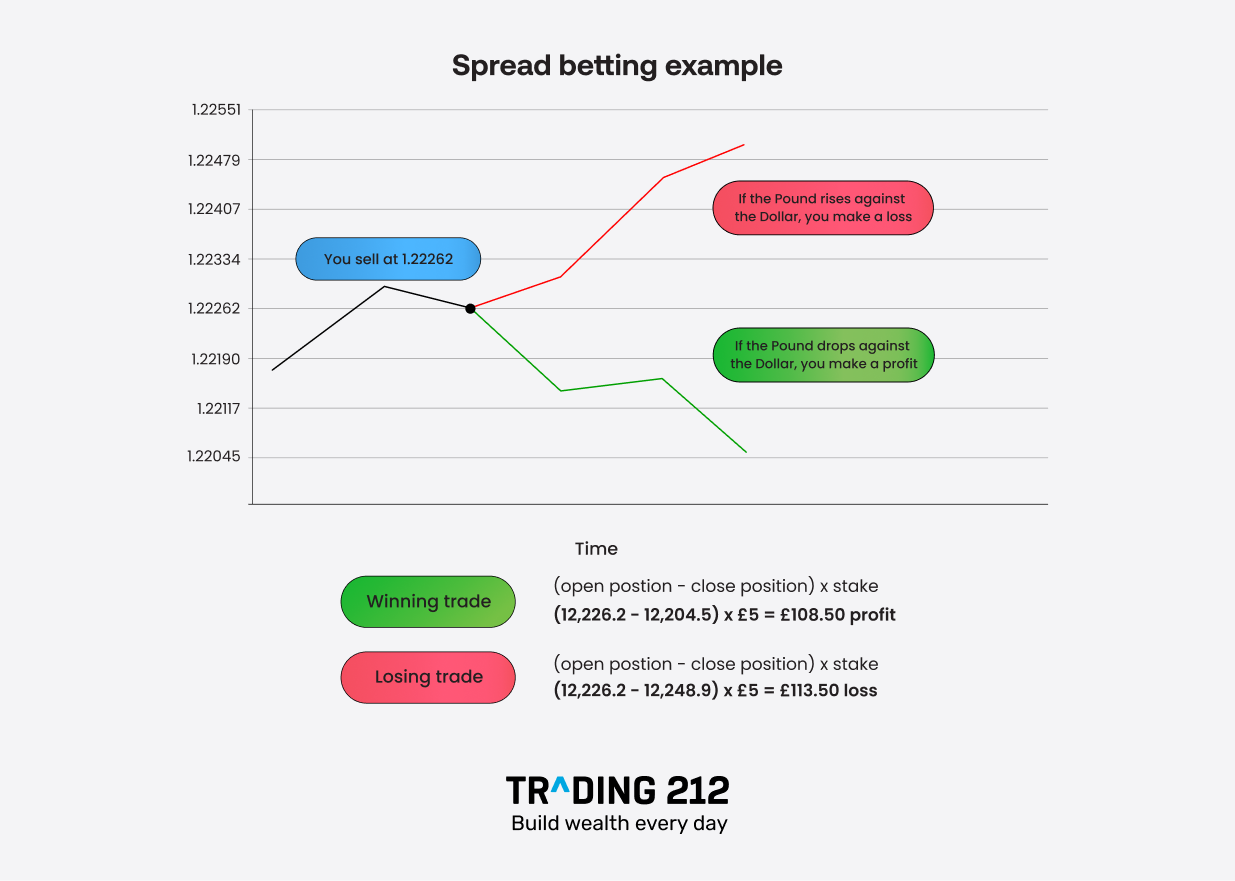
Forex spread betting also uses leverage. You only need to deposit a percentage of the full position value as margin, which makes the market more accessible but also increases risk. Overnight funding charges apply if positions are rolled into the next day, so costs need to be monitored carefully.
Because forex trades 24 hours a day, five days a week, spreads can tighten during busy sessions and widen overnight or around major economic announcements. Understanding how the spread, margin, and market hours interact is key to knowing how forex spread betting works in practice.
Because forex trades 24 hours a day, five days a week, spreads can tighten during busy sessions and widen overnight or around major economic announcements. Understanding how the spread, margin, and market hours interact is key to knowing how forex spread betting works in practice.
How to spread bet on forex
Forex spread betting follows the same basic process described above in the article, but with features unique to the currency markets. Because forex is traded 24 hours a day and is highly liquid, spreads, volatility, and margin requirements play a particularly important role.
1. Learn all about spread betting and forex trading
In forex, you are speculating on the movement of one currency against another, such as GBP/USD or EUR/JPY. Each pair is quoted with a buy and sell price, and profits or losses are measured in pips (points). Major pairs like GBP/USD typically have the tightest spreads, sometimes below one point, while exotics can carry much wider spreads and larger swings. Understanding pip values and how margin is applied is central before placing a live trade.
2. Open and fund your live spread betting account
Account setup is the same as for other spread betting markets, but forex often requires a bit more funding flexibility due to volatility. Many providers offer a demo forex account, which can be a useful way to practise with live pricing before committing real money.
3. Choose your currency pair
Majors such as GBP/USD, EUR/USD and USD/JPY are often where beginners start, as they combine liquidity with relatively low spreads. Minors and exotic pairs can be more volatile and less liquid, meaning wider spreads and faster moves. The choice comes down to how much risk you are comfortable with and which economies or currencies you want to follow.
4. Spot prices, forwards or options
Most forex spread bets are placed on spot contracts, which roll over daily and include overnight funding. Forwards allow you to take a position for a future date without daily charges, though the spread is wider. Some providers also offer options-style bets, though these are less commonly used outside advanced strategies.
5. Opening, monitoring and closing your position
Placing a forex spread bet involves choosing to buy (go long) or sell (go short), setting your stake per pip, and adding a stop loss. For example, buying GBP/USD at 1.3002 for £2 per point and closing at 1.3022 would result in a £40 gain. The same move against you would be a £40 loss. Because forex markets can move quickly, choosing an appropriate stake size and stop distance is especially important.
Legal aspects of spread betting in the UK
The sections below are designed to give you the basic legal premise of spreadbetting. However, please seek details from your provider and/or independent legal advice before you begin spread betting.
Is spread betting legal in the UK?
Spread betting is fully legal in the UK and Ireland but not permitted elsewhere. In Britain it is treated as a regulated financial product rather than gambling.
To open a spread betting account, you must be at least 18 years old and resident in a jurisdiction where spread betting is allowed. As part of the application, providers are required to check your identity and ask questions about your knowledge of leveraged trading. These suitability checks are designed to confirm that you understand concepts such as spreads, margin, and risk.
UK regulations also place limits on how providers can operate. Rules include caps on leverage for retail clients, negative balance protection (so you can't lose more than your deposit), and requirements to keep client money separate from company funds. Providers must also display clear risk warnings and avoid misleading marketing.
To open a spread betting account, you must be at least 18 years old and resident in a jurisdiction where spread betting is allowed. As part of the application, providers are required to check your identity and ask questions about your knowledge of leveraged trading. These suitability checks are designed to confirm that you understand concepts such as spreads, margin, and risk.
UK regulations also place limits on how providers can operate. Rules include caps on leverage for retail clients, negative balance protection (so you can't lose more than your deposit), and requirements to keep client money separate from company funds. Providers must also display clear risk warnings and avoid misleading marketing.
Is spread betting gambling?
Naturally given the name, one of the most common questions asked by beginners is whether spread betting is simply another type of gambling. The similarity in language can make it sound that way, but in practice financial spread betting is a regulated activity in the UK and is structured very differently from betting on sports or a casino game.
When you place a financial spread bet, your profit or loss is tied directly to the movement of an underlying market such as shares, forex, commodities or indices. The provider quotes buy and sell prices based on the actual market, and your outcome reflects how that market performs. By contrast, gambling is usually based on chance and the odds set by the bookmaker, such as predicting the outcome of a football match or even the roll of a dice.
So while spread betting carries risk and can result in losses, it is not legally classified as gambling. Instead, it sits within the category of leveraged financial trading products.
When you place a financial spread bet, your profit or loss is tied directly to the movement of an underlying market such as shares, forex, commodities or indices. The provider quotes buy and sell prices based on the actual market, and your outcome reflects how that market performs. By contrast, gambling is usually based on chance and the odds set by the bookmaker, such as predicting the outcome of a football match or even the roll of a dice.
So while spread betting carries risk and can result in losses, it is not legally classified as gambling. Instead, it sits within the category of leveraged financial trading products.
Are there regulations in the UK for spread betting?
Spread betting companies in the UK are regulated by the Financial Conduct Authority (FCA). This oversight requires providers to:
- Keep client funds segregated from company money
- Offer transparent pricing and fair marketing
- Assess client appropriateness and suitability before opening an account
- Provide risk warnings about leveraged trading
The FCA also enforces rules on maximum leverage for retail clients, restrictions on marketing bonuses, and mandatory negative balance protection to prevent clients from losing more than their deposits. These measures are designed to bring consistency between spread betting and other leveraged products such as CFDs.
Tax implications of spread betting in the UK
At present, profits made from spread betting are exempt from both Capital Gains Tax (CGT) and Stamp Duty, which are normally applied to traditional share dealing. This favourable position is one of the reasons spread betting has become popular among UK traders.
Current tax position
If you make a profit from spread betting on shares, indices, commodities, or forex, it is not considered taxable income.
Unlike owning shares outright, where Stamp Duty is paid when you buy and CGT may be owed on profits when you sell, spread betting avoids both. The same principle applies to spread betting on newer markets like cryptocurrencies.
Unlike owning shares outright, where Stamp Duty is paid when you buy and CGT may be owed on profits when you sell, spread betting avoids both. The same principle applies to spread betting on newer markets like cryptocurrencies.
Limits and caveats
- Because spread betting is tax-free on profits, losses can't be offset against other income or gains. This is different from CFDs or standard investing accounts, where losses may reduce your tax bill. In effect, the current tax rules cut both ways – no tax on gains, but no tax relief on losses.
- HM Revenue & Customs (HMRC) reviews financial products periodically, and while spread betting profits are currently treated as tax-free, there is no guarantee this will remain the case in the future.
Practical considerations
It is worth noting that spread betting is only tax-free in the UK and Ireland. If you live elsewhere, or if you change your tax residency, different rules apply.
NOTE: If spread betting is your main source of income, HMRC may choose to treat it differently, though this remains unusual in practice.
In short, spread betting’s tax treatment is a benefit compared with traditional investing or CFD trading, but it comes with trade-offs and is always subject to future government changes.
NOTE: If spread betting is your main source of income, HMRC may choose to treat it differently, though this remains unusual in practice.
In short, spread betting’s tax treatment is a benefit compared with traditional investing or CFD trading, but it comes with trade-offs and is always subject to future government changes.
Recap
Spread betting is a regulated UK financial product that allows speculation on markets such as shares, indices, forex, and commodities without owning the underlying asset. Profits and losses are determined by points gained or lost multiplied by stake size, with leverage amplifying both outcomes.
Advantages include tax efficiency, flexible long and short positions, and access to diverse markets, while risks involve margin calls, wider spreads, and rapid losses that can significantly reduce your account balance.
Clear legal oversight, favourable but conditional tax treatment, and structured approaches to risk management distinguish spread betting from traditional investing and CFDs.
Advantages include tax efficiency, flexible long and short positions, and access to diverse markets, while risks involve margin calls, wider spreads, and rapid losses that can significantly reduce your account balance.
Clear legal oversight, favourable but conditional tax treatment, and structured approaches to risk management distinguish spread betting from traditional investing and CFDs.
FAQ
Q: What is a spread in trading?
A spread is the difference between the buy (ask) price and the sell (bid) price quoted by a broker. It represents the main cost of placing a trade.
Q: Is spread betting profitable?
Spread betting can be profitable, but it is high risk because leverage amplifies both gains and losses. Outcomes depend on experience, strategy, discipline, and market conditions.
Q: Do I pay tax on spread betting?
In the UK and Ireland, spread betting profits are generally exempt from Capital Gains Tax and Stamp Duty. However, losses can't be offset against other taxable income.
Q: Is spread betting easy?
Spread betting is simple in concept but challenging in practice. Understanding the proper use of leverage and risk management takes time and discipline.
Q: Is spread betting still tax free in the UK?
Yes, spread betting remains tax free for most UK retail traders, though HMRC could treat it differently if it becomes a main source of income.
Q: Is forex spread betting tax-free in the UK?
Yes, forex spread betting is currently tax-free in the UK, with the same rules as spread betting on shares or indices.
Q: What is the difference between spread betting and options?
Spread betting involves staking a set amount per point of movement, while options are a distinct financial product that give the right, but not the obligation, to buy or sell at a fixed price before expiry.
Q: Who regulates spread betting in the UK?
Spread betting providers are authorised and supervised by the Financial Conduct Authority (FCA).
Q: What does 0.3 spread mean in forex?
A 0.3 spread means the difference between the buy and sell price is 0.3 pips. For example:
Bid: 1.12550 / Ask: 1.125503
Bid: 1.12550 / Ask: 1.125503
Q: Is forex spread betting regulated in the UK?
Yes, forex trading in the UK is regulated by the FCA, covering brokers that offer both spread betting and CFD accounts.
Q: What is spread betting leverage in the UK?
Leverage in spread betting is capped by FCA rules, with typical maximums of 30:1 on major forex pairs and lower levels on other assets.
Q: Is MT5 spread betting?
MT5 (MetaTrader 5) is a trading platform that supports spread betting. Whether you can access spread betting via an MT5 platform depends on the broker offering it.
Q: Is MT4 spread betting or CFD?
Again, MT4 (MetaTrader 4) is a platform. In the UK, brokers usually offer it for CFD trading, though some enable spread betting accounts as well.