What is an Equity Fund? Types, benefits, risks, and alternatives
In the investment world, equity is just a fancy name for stocks. An equity fund is simply a fund that consists predominantly of stocks, such as Apple (APPL), Google (GOOG), or similar.
However, there are many different kinds of stocks and equity funds that you can build, create, and automate around.
However, there are many different kinds of stocks and equity funds that you can build, create, and automate around.
QUOTE
How many millionaires do you know who have become wealthy by investing in savings accounts?
Big ideas
- Equity funds are a way to invest in a diversified portfolio of stocks, minimising volatility exposure and reducing the need for continual stock selection and evaluation.
- Equity funds can be classified according to the type of underlying stock they are concerned with. They are often used by investors seeking long-term market participation without selecting individual stocks.
- Equity funds can be passively or actively managed. Due to technological advances, passive investing via robo advisors enables retail investors to invest in diversified equity fund ETFs for the long term, based on their risk tolerances, with automatic rebalancing.
What is an equity fund?
DEFINITION
An equity fund is a fund made up of stocks, with a specific theme or focus. It can be a mutual fund or an exchange-traded fund (ETF).
The general idea is that instead of stock picking, you can invest in a fund or a few funds that have invested in underlying stocks. This provides immediate diversification and saves time researching companies to invest in, leaving the most significant decision on which asset manager to invest with.
These funds can be classified into various categories, such as:
These funds can be classified into various categories, such as:
- Active vs Passive
- Growth vs Value
- Small cap vs Large cap, etc
- Thematic
These are discussed in more detail below.
An equity fund pools money from different investors. It can be actively managed by a professional manager, and investors can look up past performance, expense ratios, and other key criteria before deciding on a particular fund. Most often, publicly traded stocks are invested in.
Alternatively, the fund can be passively managed. This is more of a low-fee set-and-forget approach, where you invest in an array of stocks based on your risk tolerance. Passively managed portfolios have, for a number of years, on average, outperformed actively managed portfolios when fees and taxes are accounted for. However, performance varies and is not guaranteed.
An equity fund pools money from different investors. It can be actively managed by a professional manager, and investors can look up past performance, expense ratios, and other key criteria before deciding on a particular fund. Most often, publicly traded stocks are invested in.
Alternatively, the fund can be passively managed. This is more of a low-fee set-and-forget approach, where you invest in an array of stocks based on your risk tolerance. Passively managed portfolios have, for a number of years, on average, outperformed actively managed portfolios when fees and taxes are accounted for. However, performance varies and is not guaranteed.
Equity mutual funds vs Index funds vs ETFs
There is a good amount of overlap between these three terms, which are often used interchangeably, but they each refer to different ways of investing in shares as part of a fund.
An index fund is a type of mutual fund that passively tracks an index, while ETFs are mostly designed to do the same (track an index) but in a structure that allows them to be traded like shares. However, most equity mutual funds are actively managed, and some equity ETFs are actively managed.
An index fund is a type of mutual fund that passively tracks an index, while ETFs are mostly designed to do the same (track an index) but in a structure that allows them to be traded like shares. However, most equity mutual funds are actively managed, and some equity ETFs are actively managed.
Feature | Mutual funds | Index funds | ETFs (Exchange-traded funds) |
Management style | Usually active | Passive and tracks an index | Mostly passive (some active ETFs exist) |
Pricing | Priced once daily at NAV | Priced once daily at NAV | Real-time pricing during market hours |
Trading flexibility | Buy/Sell at daily cut-off | Buy/Sell at daily cut-off | Buy/Sell any time during market hours |
Fees | Generally higher | Lower | Low ongoing fees, but may pay a spread |
Bid-Ask spread | Not applicable | Not applicable | Yes, like trading shares |
Broker commission | Often none | Often none | May apply depending on the platform |
Minimum investment | Often higher | Typically lower | Low, sometimes fractional shares allowed |
Liquidity | Less liquid – one price per day | Less liquid – one price per day | High liquidity (depending on volume) |
Structure | Traditional fund | Traditional fund | A traded fund (like a share) |
Suited for | Investors seeking potential outperformance | Cost-conscious, long-term investors | Hands-on investors wanting flexibility |
Types of equity funds
The type of equity fund you choose will depend on your goals. One benefit of investing in an equity fund is that you gain diversified exposure to a number of stocks specifically selected by the fund manager. This reduces the risk of investing in a poorly-run or mispriced business.
Equity funds are often classified as moderate, conservative, aggressive, etc, so investors can choose what kind of equity portfolio they desire. Going beyond that, they can be subdivided further into categories such as the following:
Equity funds are often classified as moderate, conservative, aggressive, etc, so investors can choose what kind of equity portfolio they desire. Going beyond that, they can be subdivided further into categories such as the following:
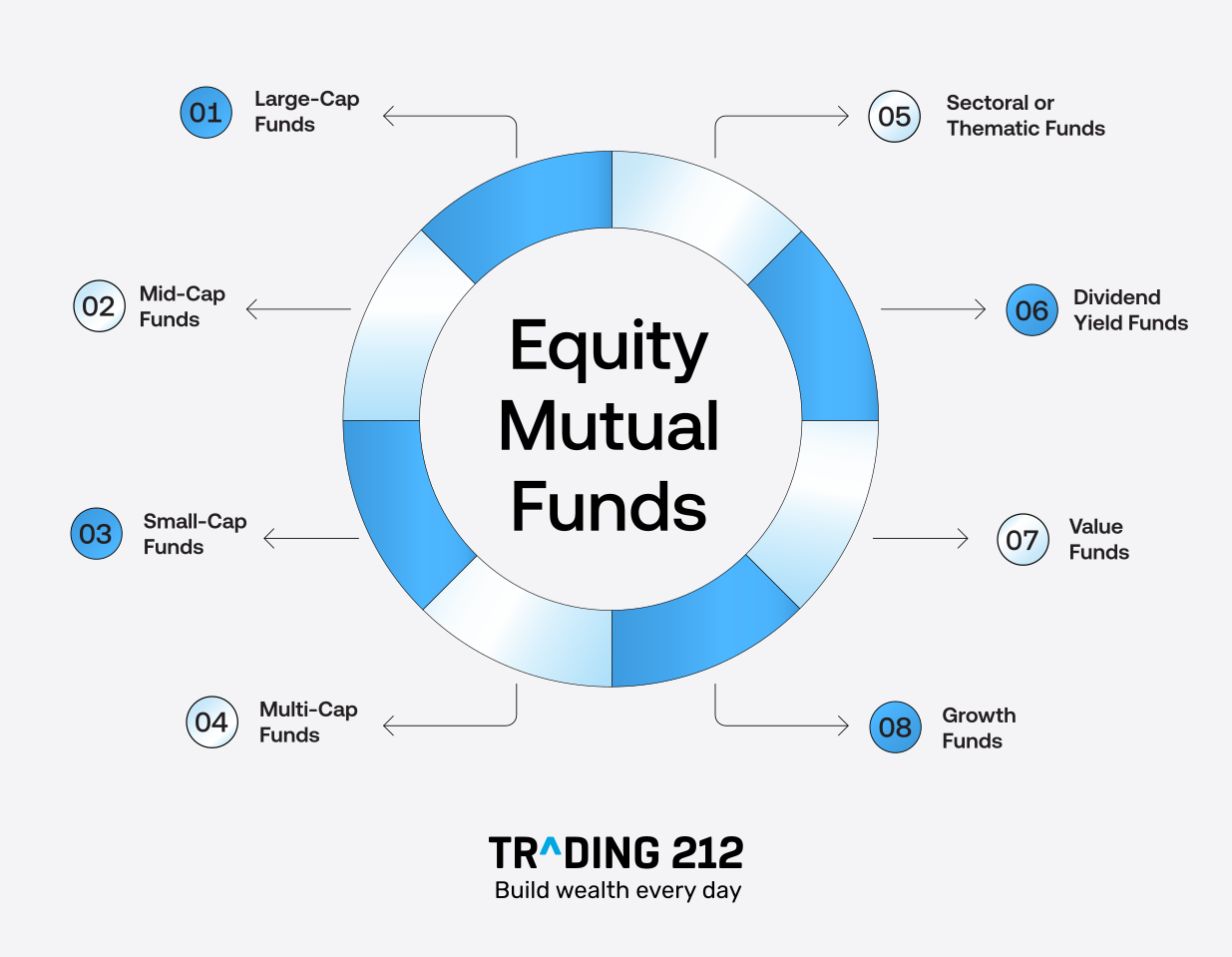
Active vs Passive equity funds
Active equity funds are managed by professionals who select stocks to outperform a benchmark index such as the FTSE 100, DAX 40, or S&P 500. These funds charge higher fees but aim for better returns.
Passive equity funds track an index like the FTSE All-Share or MSCI UK. They have lower costs and usually match market performance. Investors tend to pick based on fees.
Passive equity funds track an index like the FTSE All-Share or MSCI UK. They have lower costs and usually match market performance. Investors tend to pick based on fees.
Growth vs Value equity funds
Growth funds focus on companies with substantial revenue expansion, often in sectors like technology or biotech. These firms reinvest earnings rather than pay dividends.
Value funds target undervalued stocks, often in industries such as financials or utilities. Growth funds often do well in bullish markets, while value funds tend to hold up better in downturns. However, performance outcomes are not guaranteed and depend on market conditions.
Value funds target undervalued stocks, often in industries such as financials or utilities. Growth funds often do well in bullish markets, while value funds tend to hold up better in downturns. However, performance outcomes are not guaranteed and depend on market conditions.
Equity funds by market capitalisation
Equity funds invest in large-cap (FTSE 100), mid-cap (FTSE 250), or small-cap (FTSE SmallCap Index) stocks. Large-cap stocks tend to be less volatile, mid-caps balance growth and risk, and small-caps offer high return potential but with more expected volatility. The choice depends on risk tolerance and investment goals.
Sector/Thematic equity funds
Sector equity funds focus on industries such as financials, energy, healthcare, or consumer goods. Investors use them to target specific opportunities, often alongside broader equity funds.
Thematic funds are invested in high-growth areas like blockchain, fintech, and renewables. These funds perform well when the sector or theme is strong, but can be volatile.
Thematic funds are invested in high-growth areas like blockchain, fintech, and renewables. These funds perform well when the sector or theme is strong, but can be volatile.
Geographical equity funds
Geographical equity funds offer investors exposure to domestic or international markets. UK-focused funds invest in FTSE-listed companies, while global funds include US, European, or emerging market stocks. Some funds concentrate on regions like Asia-Pacific or North America. Currency fluctuations and regional economic conditions affect returns, making diversification an essential factor.
Equity funds table overview
The following table outlines some of the different equity funds available.
Equity fund type | Description |
Large cap | Invest in well-established companies with large market capitalisation. |
Mid cap | Focus on companies with medium market capitalisation. |
Small cap | Invest in smaller, emerging companies with high growth potential. |
Index | Passive funds that track a specific stock market index. |
Sectorial/Thematic | Invest in specific industries like technology, healthcare, or energy. |
International | Invest in stocks from global markets outside the investor’s home country. |
Growth | Invest in companies with substantial revenue and earnings growth potential. |
Value | Focus on undervalued stocks with strong fundamentals. |
NOTE: With Trading 212’s Pies, it is also possible to mix and match, creating hybrid equity funds with stocks of your choosing, combining the best active and passive investments. Ready-made pies offer solely data on investment allocations and should not be regarded as investment advice or investment research. You are responsible for all investment and rebalancing decisions.
Factors to consider when selecting an equity fund
Picking an equity fund means looking at key factors that affect returns and risk. Four of the most essential items to understand include:
- Risk tolerance is one of the first things to consider when choosing an equity fund. Some investors prefer stability, while others accept more risk for higher potential gains. Large-cap funds are steadier. Small-cap and sectoral funds can be volatile but offer higher growth potential.
- Past performance matters but should not be solely relied upon further short-term results do not tell the full story. A fund that consistently performs well across different market conditions is more reliable. Comparing returns to a benchmark index helps to gauge performance.
- Expense ratios are a common term related to equity funds and have a significant impact on total profit. Actively managed funds charge higher fees, but they need to justify their cost by outperforming passive funds. Low-cost index funds are a good option for those who want market returns with lower fees.
- Investment horizon relates to how long you can invest. Time in the market is a key factor in wealth creation. A long-term investor can handle short-term price swings and invest in high-growth funds, while a short-term investor might look for funds with lower volatility.
- The manager or provider – if you are considering an actively managed fund, look at the fund manager’s track record and experience. A long-standing manager with an excellent reputation, a style you like, and consistent results adds confidence.
For passive funds like index funds and ETFs, the focus shifts to the stability and reputation of the fund provider. Well-established names like Vanguard, BlackRock (iShares), or Fidelity are known for low costs, efficient tracking, and transparency, all things that matter over the long haul.
You must also choose whether you want an actively or passively managed fund. An equity fund can form a part of your broader portfolio – you might want to combine it with commodities, bonds, or cash, for a more well-rounded financial landscape.
You must also choose whether you want an actively or passively managed fund. An equity fund can form a part of your broader portfolio – you might want to combine it with commodities, bonds, or cash, for a more well-rounded financial landscape.
Alternatives to equity funds
Equity investing is typically linked to higher levels of risk and the potential for long-term capital growth. Many investors choose to make equities a central part of their portfolios. However, it is common to include other asset classes alongside them to help manage risk and broaden market exposure. While diversification cannot guarantee returns, it may reduce reliance on the performance of any single market.
Asset type | Characteristics | Potential benefits | Key considerations |
Bonds | Invest in government, municipal, or corporate bonds. | Regular income, potential for stability, risk diversification. | Lower returns, sensitive to interest rate changes. |
Commodities | Direct investment in physical commodities or through ETFs. | Hedge against inflation, portfolio diversification. | High volatility, no passive income. |
Private equity | Investment in privately held companies or buyouts. | High return potential, direct involvement in businesses. | Long lock-up periods, high minimum investment. |
Hedge funds | Actively managed funds using various strategies. | Potential for high returns, flexibility in asset selection. | High fees, less transparency, and limited access for retail investors. |
Fixed deposits/MMFs | Invest in low-risk, short-term financial instruments. | Capital preservation, liquidity, and low volatility. | Very low returns, may not beat inflation. |
Cryptocurrencies | Digital assets with decentralised networks. | High growth potential, 24/7 trading, global access. | Extreme volatility, regulatory uncertainty, and cybersecurity risks. |
Tax implications for equity funds
Returns from equity funds are taxed, and you will also need to have a tax strategy in place when selecting an equity fund. In the UK, equity fund returns are subject to capital gains tax (CGT) and dividend tax.
As of July 2025, if gains exceed the annual tax-free allowance of £6,000, you will owe tax. Basic rate taxpayers pay 10%, while higher rate taxpayers pay 20%. The tax-free allowance for dividends is £1,000.
Investing through wrappers like ISAs and pensions eliminates CGT and dividend tax on holdings within these accounts.
For offshore funds, tax treatment varies depending on reporting status.
These figures apply specifically to UK taxpayers. Tax rules differ in other countries and jurisdictions. Failing to account for tax implications can reduce long-term returns, so it is important to consider this alongside management fees when evaluating equity funds.
As of July 2025, if gains exceed the annual tax-free allowance of £6,000, you will owe tax. Basic rate taxpayers pay 10%, while higher rate taxpayers pay 20%. The tax-free allowance for dividends is £1,000.
Investing through wrappers like ISAs and pensions eliminates CGT and dividend tax on holdings within these accounts.
For offshore funds, tax treatment varies depending on reporting status.
These figures apply specifically to UK taxpayers. Tax rules differ in other countries and jurisdictions. Failing to account for tax implications can reduce long-term returns, so it is important to consider this alongside management fees when evaluating equity funds.
Recap
Equity investing is commonly used for long-term capital growth, though it involves market risk and may not suit all investors. Strategies such as dollar-cost averaging can help manage volatility, but outcomes still depend on market conditions and the underlying assets.
Many equity funds offer built-in diversification, often holding more than the commonly referenced threshold of 25 stocks. Some investors choose to combine broad-based equity ETFs with individually selected stocks to align with their own research and preferences.
Potential risks include delayed entry into the market or switching strategies too frequently. Portfolios may benefit from periodic rebalancing to maintain a consistent risk profile. Allocating across asset classes – such as equities, cash, and bonds – can also help diversify exposure and manage volatility over time.
Many equity funds offer built-in diversification, often holding more than the commonly referenced threshold of 25 stocks. Some investors choose to combine broad-based equity ETFs with individually selected stocks to align with their own research and preferences.
Potential risks include delayed entry into the market or switching strategies too frequently. Portfolios may benefit from periodic rebalancing to maintain a consistent risk profile. Allocating across asset classes – such as equities, cash, and bonds – can also help diversify exposure and manage volatility over time.
FAQ
Q: What is an equity fund?
An equity fund is a type of investment fund that mainly buys stocks. It pools money from many investors to purchase shares in publicly traded companies. The objective is to generate returns through capital appreciation and dividends. These funds can focus on different sectors, market sizes, or regions. They are managed by professionals or follow index strategies.
Q: How do equity funds work?
Equity funds collect money from investors and use it to buy stocks. A fund manager decides which stocks to buy and sell based on the fund’s strategy. Investors own shares in the fund, not the stocks directly. The value of the investment changes as stock prices move. Some funds track an index, while others are actively managed.
Q: Is an ETF an equity fund?
Many ETFs are structured as equity funds because they invest primarily in stocks. They trade like shares on an exchange and usually track an index. Unlike traditional mutual funds, ETFs can be bought and sold daily. Some ETFs focus on specific sectors, while others cover broad markets. Some ETFs invest in bonds or commodities instead of stocks.
Q: Who invests in private equity?
Private equity is often accessed by institutional investors, high-net-worth individuals, and family offices. Pension, endowments, and sovereign wealth funds also allocate money to private equity. These investors commit capital to funds that buy private companies or take large stakes in public ones. The objective is to improve operations, increase value, and sell the investment for a profit.
Q: Is equity a form of wealth or income?
Equity is a form of wealth, not income. It represents ownership in a company or an asset. The value of equity changes over time based on market conditions and business performance. Income comes from salaries, dividends, or interest.
Q: How is equity calculated?
Equity is calculated by subtracting liabilities from assets. The basic formula is:
Equity = Assets − Liabilities
In a company, equity includes retained earnings and shareholder investments. For individuals, home equity is the difference between the property value and the mortgage balance. Positive equity means assets are worth more than debts, while negative equity implies the opposite.
Equity = Assets − Liabilities
In a company, equity includes retained earnings and shareholder investments. For individuals, home equity is the difference between the property value and the mortgage balance. Positive equity means assets are worth more than debts, while negative equity implies the opposite.