The role of the central banks: Impact on economy and investors
When central banks adjust interest rates, the ripple effect can reach everything from your job to mortgage rates to the stock market. Here is how their decisions shape the economy and influence the investment decisions you can take.
QUOTE
Earnings don’t move the overall market; it’s the Federal Reserve Board… focus on the central banks and focus on the movement of liquidity.
– Stanley Druckenmiller
– Stanley Druckenmiller
Big ideas
- Central banks don’t just set interest rates, they also buy and sell government bonds, manage currency reserves, and influence how much money circulates in the economy, often without most people realising.
- The Bank of England targets a 2% inflation rate, but it isn't just a number plucked from thin air – it is seen as the sweet spot where prices rise steadily enough to encourage spending without eroding purchasing power.
- When the Bank of England or Federal Reserve hints at future policy through forward guidance, markets often move long before any rate change actually happens, showing that words alone can move billions.
- Quantitative easing (QE) and quantitative tightening (QT) are opposite sides of the same coin: one injects money into the financial system to stimulate growth, while the other drains it to control inflation – both can reshape markets far beyond their borders.
Central bank mandates and objectives
What do central banks do?
Central banks oversee how much money circulates in the economy, influence borrowing costs, and help keep prices stable so that the economy grows steadily without overheating.
Once you understand what they aim to achieve, it helps make sense of why interest rates change in one direction or another, and why comments from central bankers often dominate market headlines.
Once you understand what they aim to achieve, it helps make sense of why interest rates change in one direction or another, and why comments from central bankers often dominate market headlines.
Price stability: The core mission of central banks
For most central banks, so-called price stability is the main goal. Rising prices are what is known as inflation. You might think stability would mean zero percent inflation but actually central banks tend to aim for gradual inflation and usually take actions to avoid deflation (falling prices).
When prices rise too quickly, it weakens people’s spending power but when prices fall for too long, businesses stop investing and hiring because they can’t be sure they will get a return on investment.
By keeping inflation predictable, central banks aim to create the conditions for stable growth and financial confidence.
When prices rise too quickly, it weakens people’s spending power but when prices fall for too long, businesses stop investing and hiring because they can’t be sure they will get a return on investment.
By keeping inflation predictable, central banks aim to create the conditions for stable growth and financial confidence.
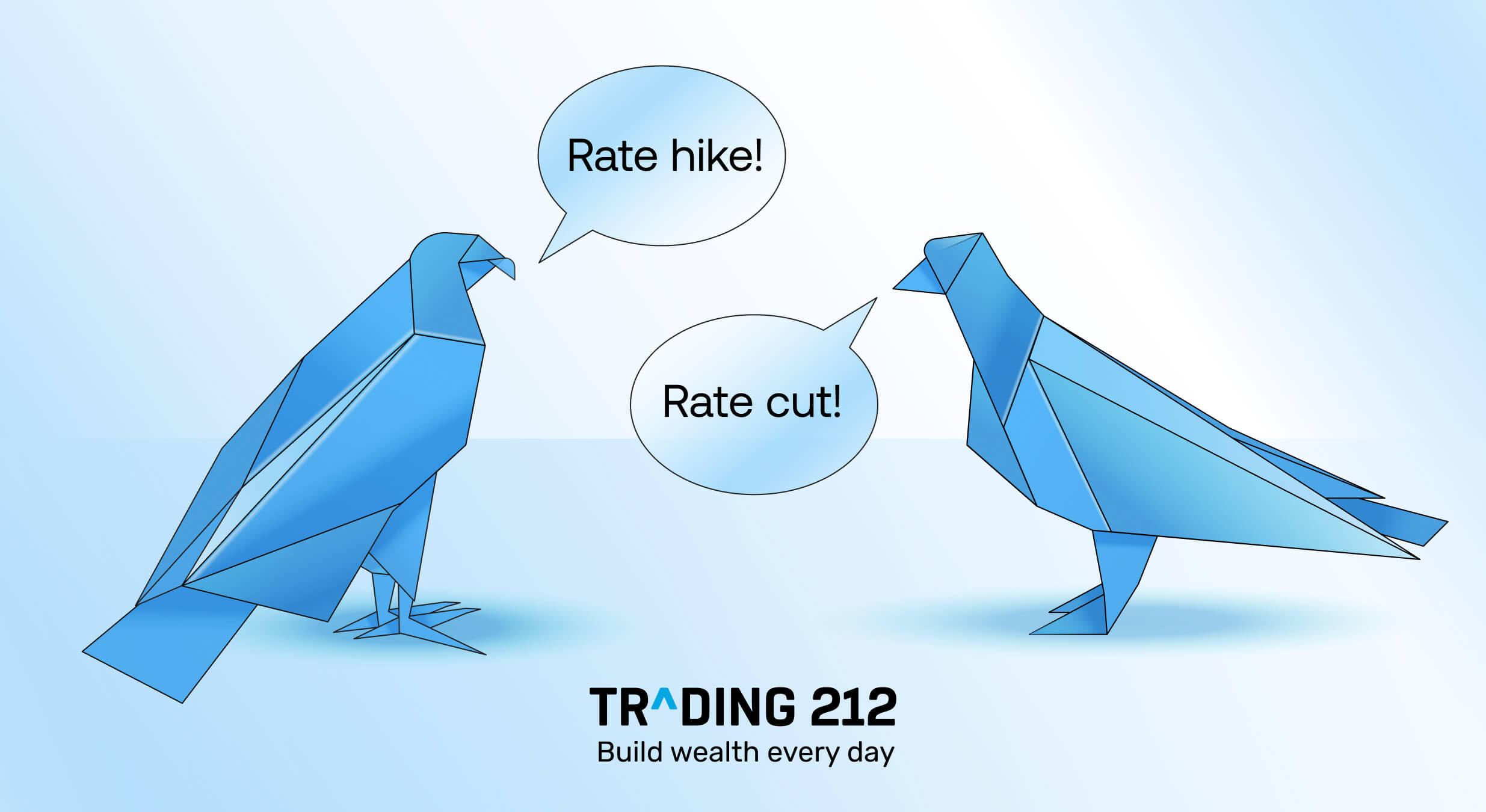
- Economists and central bankers that view inflation as too high are known as hawks. Their viewpoint is therefore hawkish.
- Those that view inflation as too low are known as doves and their views are dovish.
However, central banks are not without their critics, with some pointing to the long term value destruction of a currency through inflation. The chart below illustrates how the value of one U.S. dollar has steadily decreased over the past century.
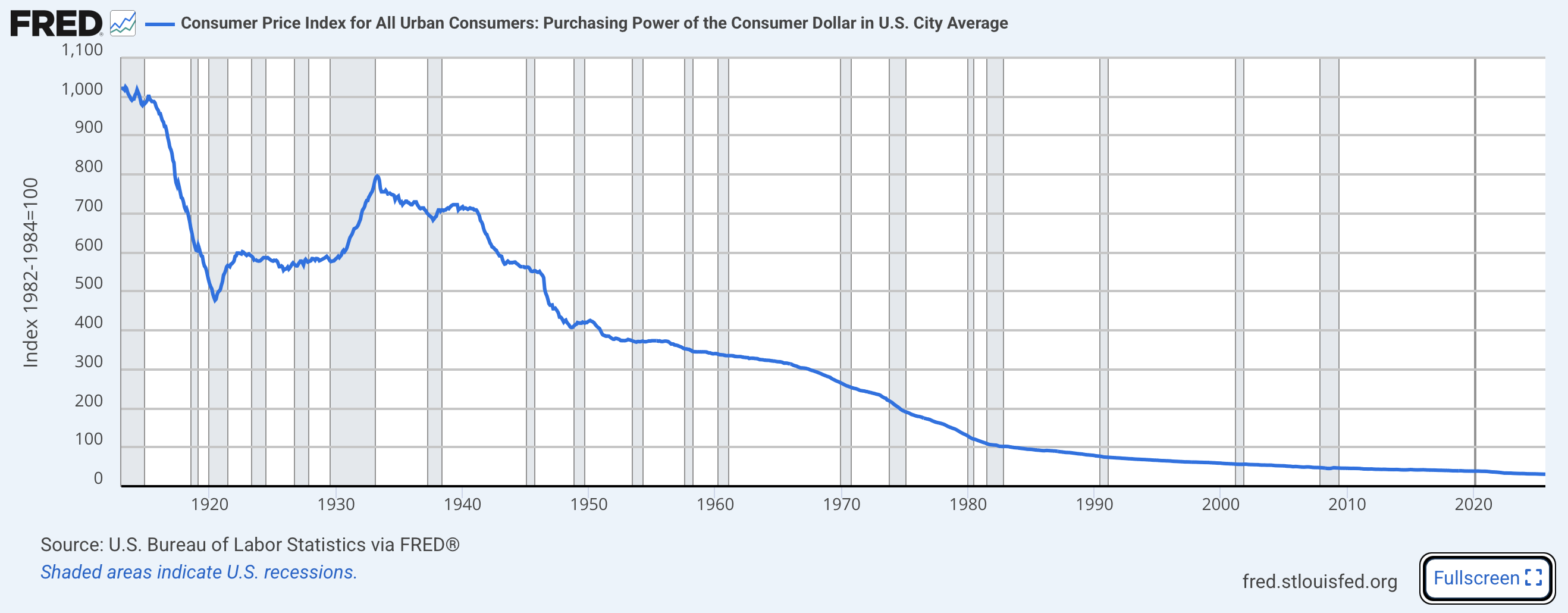 Source: U.S. Bureau of Labor Statistics via FRED® .This example is for illustration purposes only and does not constitute financial advice. Past performance is not indicative of future results.
Inflation targeting and consumer price index (CPI)
Inflation targeting is how central banks turn the previous goal into action. In the UK, the Bank of England’s inflation target of around 2% is designed to achieve the right balance for the economy. The US Federal Reserve and the European Central Bank (ECB) have similar targets.
The Consumer Price Index (CPI) is the most widely used measure, and is released every month for all the major economies. Any big deviation from consensus expectations can have an effect on the stock market as well as bond and currency markets.
The Consumer Price Index (CPI) is the most widely used measure, and is released every month for all the major economies. Any big deviation from consensus expectations can have an effect on the stock market as well as bond and currency markets.
DEFINITION
CPI tracks how the average cost of a basket of goods and services changes over time.
When inflation rises far above target, central banks may increase interest rates to cool spending. When it falls too low, they may cut rates or introduce new measures to stimulate demand. It is a constant balancing act between keeping money stable and keeping the economy moving.
Dual mandates: Balancing growth and employment
Unlike the Bank of England and ECB, which focus primarily on price stability, the Federal Reserve has a dual mandate that includes both:
- Stable prices
- Maximum employment
The challenge lies in supporting growth and jobs without allowing inflation to run away uncontrollably. Economic students learn about the Phillips curve, even though its validity has been challenged empirically; the logic of a trade off between inflation and unemployment is viewed as useful.
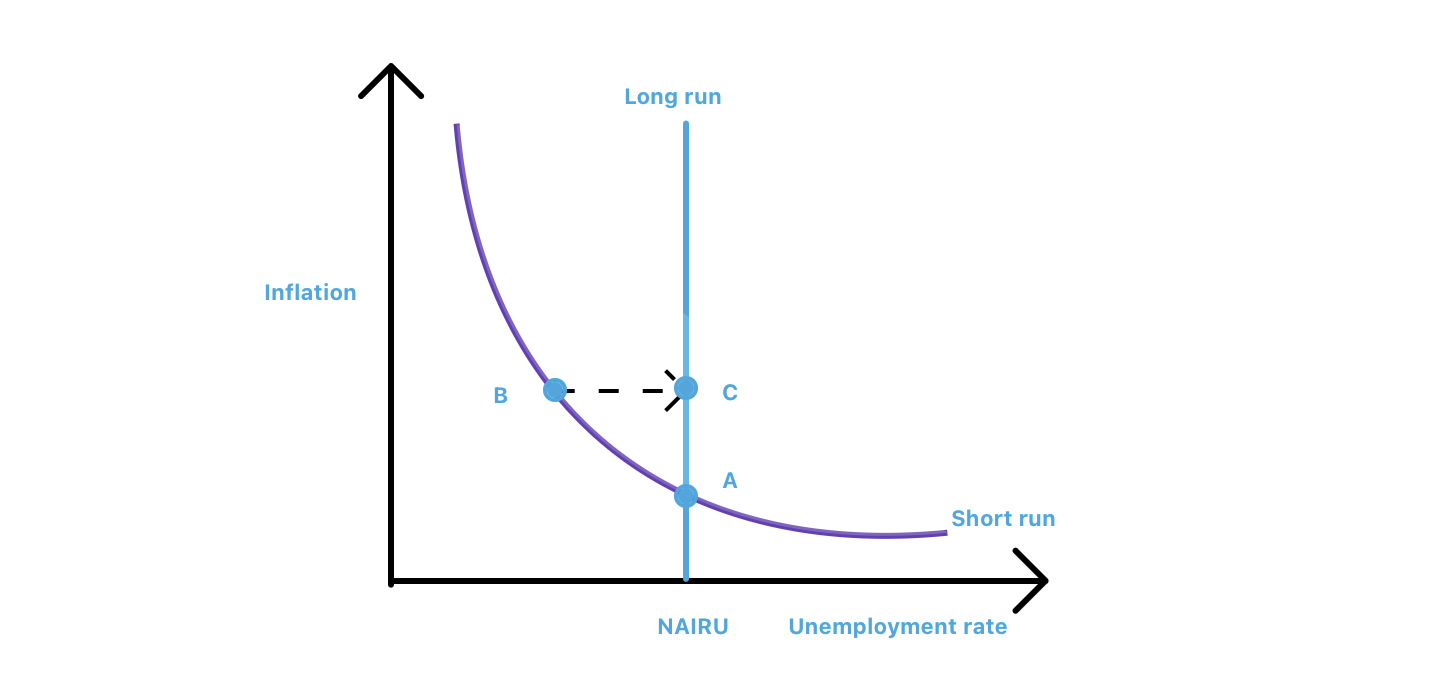
When the economy slows, lowering interest rates can boost borrowing by making it cheaper to do so, which encourages spending and higher employment. However, too much stimulus for too long can feed into rising prices later on.
The economists who research the economy at central banks, which forms the basis for policy decisions, try to understand the Non-Accelerating Inflation Rate of Unemployment (NAIRU).
The economists who research the economy at central banks, which forms the basis for policy decisions, try to understand the Non-Accelerating Inflation Rate of Unemployment (NAIRU).
DEFINITION
The NAIRU represents the lowest level of unemployment an economy can maintain without triggering faster wage growth and rising inflation. It is a useful way of assessing how much slack, or spare capacity, remains in the labour market.
Exchange rate stability and currency management
Central banks also monitor the value of their national currency, though tend to not explicitly acknowledge the exchange rate as a policy goal. A stable exchange rate supports trade and investment by maintaining certainty for importers and exporters. Some central banks, especially in smaller or export-led economies, occasionally intervene in currency markets to smooth excessive volatility.
Monetary policy tools
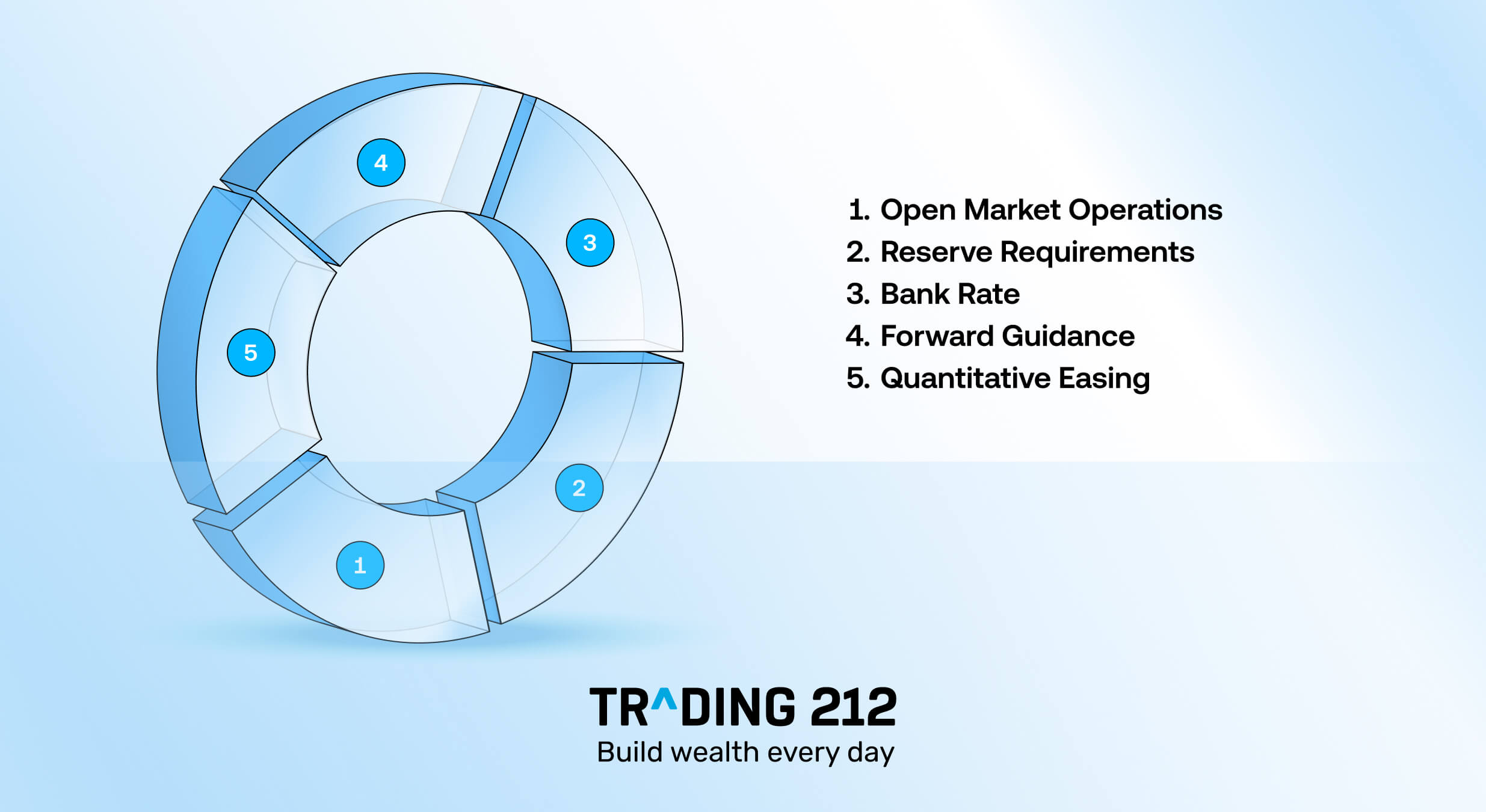
Central banks use a range of tools or techniques to influence the money supply and perhaps as important - expectations about the money supply. These affect how easily money flows through the financial system, shaping everything from the cost of a mortgage to business lending rates.
How interest rates shape the economy
In the UK, the Bank of England’s Monetary Policy Committee decides the bank rate, which determines how much it costs commercial banks to borrow money. Other central banks use a different name for it, but the idea is the same. The Federal Reserve calls it the discount rate, for the ECB it is the marginal lending facility rate and the Bank of Japan uses what it terms the basic loan rate, etc. Those rates then get passed on to households and businesses via loans, credit cards, and savings rates determined by banks.
EXAMPLE
The current interest rate is 2.75% but the central bank has decided to lower interest rates by 0.25% to 2.5%.
In financial market jargon, this is referred to as cutting rates by 25 basis points.
Had it decided to raise rates by 0.5% to 3.25%, this would be referred to as hiking rates by 50 basis points.
In financial market jargon, this is referred to as cutting rates by 25 basis points.
Had it decided to raise rates by 0.5% to 3.25%, this would be referred to as hiking rates by 50 basis points.
The general theory is that lowering interest rates makes borrowing cheaper and encourages spending and investment, while raising them helps cool demand and contain inflation.
Of course, theories don’t always bear out in the real economy – which is often a function of both demand for as well as the supply of money. The result of which can be that interest rates are high while there is high demand for money to pay for goods and services and interest rates are low when demand for money slows.
Of course, theories don’t always bear out in the real economy – which is often a function of both demand for as well as the supply of money. The result of which can be that interest rates are high while there is high demand for money to pay for goods and services and interest rates are low when demand for money slows.
Reserve requirements and bank liquidity
DEFINITION
Reserve requirements are the minimum proportion of deposits from customers that commercial banks must hold onto rather than lend out.
By changing this ratio, a central bank can tighten or loosen credit conditions. Although reserve requirements are adjusted much less frequently in advanced economies today, they remain a key tool in shaping liquidity and financial stability in other parts of the world.
Open Market Operations explained
DEFINITION
Open market operations are the routine buying or selling of government bonds by a central bank to control short-term interest rates and the supply of money.
When a central bank buys bonds, it does so with reserves it has created, which injects funds into the banking system, which can be used by the banks for lending and has the effect of lowering interest rates on the bonds (by pushing up bond prices). When it sells bonds, vice versa, then it is withdrawing reserves and pushing rates higher.
These daily transactions are one of the quieter but most essential levers of central banking.
These daily transactions are one of the quieter but most essential levers of central banking.
Quantitative easing (QE): Boosting growth in crises
In recent years since the 2008 financial crisis, when interest rates are already near zero, central banks have turned to quantitative easing (QE).
Under QE, a central bank creates new money electronically to purchase government and corporate bonds. This is similar to OMOs but this time the new reserves created are with the explicit purpose of expanding the money supply to drive down long term interest rates- it is done on a much larger scale and for a longer period.
Both the Bank of England and Federal Reserve used QE extensively after the 2008 financial crisis and again during the covid-19 pandemic to stabilise markets and support recovery.
In short:
Under QE, a central bank creates new money electronically to purchase government and corporate bonds. This is similar to OMOs but this time the new reserves created are with the explicit purpose of expanding the money supply to drive down long term interest rates- it is done on a much larger scale and for a longer period.
Both the Bank of England and Federal Reserve used QE extensively after the 2008 financial crisis and again during the covid-19 pandemic to stabilise markets and support recovery.
In short:
- OMO = everyday, small-scale, short-term liquidity management.
- QE = crisis-era, large-scale money creation aimed at boosting growth and confidence.
Quantitative tightening (QT): Fighting inflation
Quantitative tightening reverses what it did during QE. Instead of buying assets, the central bank lets bonds mature or sells them back into the market, removing liquidity from the financial system.
The purpose is to slow inflation by reducing the amount of money circulating in the economy. However, QT can also lead to more volatility in bond and equity markets as investors adjust to a less supportive environment.
The purpose is to slow inflation by reducing the amount of money circulating in the economy. However, QT can also lead to more volatility in bond and equity markets as investors adjust to a less supportive environment.
Unconventional monetary policy tools
Beyond these main levers, some central banks have experimented with unconventional policies such as:
- Negative interest rates (NIRP)
- Yield curve control (YCC)
- Targeted lending schemes
These measures are typically used in times of stress or uncertainty, when normal monetary policy isn't enough to guide the economy or help spur confidence in financial markets.
Policy decision-making process
How do central banks decide when to change policy, keep it the same or even when to take more drastic action?
Understanding how these institutions go about making these choices helps you plan ahead for likely policy outcomes, and adjust your investments accordingly.
Understanding how these institutions go about making these choices helps you plan ahead for likely policy outcomes, and adjust your investments accordingly.
Who makes central bank decisions?
Decisions about monetary policy are usually made by a small committee from a board of governors rather than a single governor.
In the UK, this responsibility lies with the Monetary Policy Committee (MPC) of the Bank of England, made up of internal members from the Bank and external experts appointed by the government.
Other central banks, such as the Federal Reserve’s Federal Open Market Committee (FOMC) and the European Central Bank’s Governing Council, operate in a similar way.
While the governor acts as the public face of the decision, outcomes are based on majority votes. Each member has an equal vote, and meetings typically include presentations from economists, analysis of financial conditions, and debate over the appropriate policy stance.
In the UK, this responsibility lies with the Monetary Policy Committee (MPC) of the Bank of England, made up of internal members from the Bank and external experts appointed by the government.
Other central banks, such as the Federal Reserve’s Federal Open Market Committee (FOMC) and the European Central Bank’s Governing Council, operate in a similar way.
While the governor acts as the public face of the decision, outcomes are based on majority votes. Each member has an equal vote, and meetings typically include presentations from economists, analysis of financial conditions, and debate over the appropriate policy stance.
How often do central banks meet?
The Bank of England’s MPC meets once a month to set interest rates, while the Federal Reserve and European Central Bank meet nearly every month in eight meetings per year. These meetings are scheduled in advance, and a statement alongside minutes are published afterward to explain the reasoning behind each decision.
Forward guidance: Signaling future policy moves
The other big part of what central banks do is to manage expectations about where it might go next so that the transmission of that policy intention is done via the way private entities react.
DEFINITION
Forward guidance is the communication strategy used to signal likely future decisions on interest rates or asset purchases.
In many cases, this communication plays a bigger role in shaping expectations and therefore the behaviour of banks, businesses, and investors than the actual interest rate changes.
The main issue with this policy technique is that it requires competent economic forecasting for the central bank to know what it plans to do in the future. However, the future by definition is uncertain and hard to forecast.
The main issue with this policy technique is that it requires competent economic forecasting for the central bank to know what it plans to do in the future. However, the future by definition is uncertain and hard to forecast.
The role of central bank independence
When central banks can make decisions free from short-term political pressure, they are better able to maintain credibility with markets and the public. Independence helps ensure that policy choices are based on economic evidence rather than political timing.
Economic indicators central banks track
Central banks base their policy decisions on a series of economic indicators (including how they are tracking over time) that help them assess the current state of the economy, here are some of the main ones.
Indicator | What it measures | Why it matters | Examples and notes |
Inflation metrics | Price changes in goods and services across the economy. | Inflation directly affects price stability and purchasing power. | CPI (Consumer Price Index) is the main UK measure; Core CPI removes food and energy volatility; PPI (Producer Price Index) shows factory-gate prices; PCE (Personal Consumption Expenditures) is closely watched in the US. |
GDP and growth trends | Total output of goods and services produced in the economy. | Indicates overall economic momentum and whether demand is running too hot or too cold. | Strong GDP growth may prompt higher rates to prevent the economy overheating; weak GDP can lead to looser policy to stimulate activity. |
Labour market data | Employment levels, wage growth, and participation rates. | Reveals spare capacity in the economy and potential inflation pressure from rising wages. | Includes the unemployment rate and Non-Farm Payrolls (NFP) in the US. When unemployment falls below the NAIRU, wage-driven inflation risks increase |
Housing and real estate indicators | House prices, mortgage approvals, and construction activity. | Reflects the transmission of monetary policy into the property market. | Lower rates can lift house prices and confidence; higher rates can slow demand and cool credit growth. |
Financial stability and stress tests | Health and resilience of the banking system. | Ensures banks can withstand shocks and continue lending during downturns. | Regular stress tests and capital requirements help safeguard liquidity and confidence in the wider financial system. |
Central banks and global markets
When major central banks like the Bank of England, the Federal Reserve, or the European Central Bank shift policy, the effects ripple through global markets.
How central bank policies affect currency exchange rates
When a central bank raises interest rates, it typically strengthens the national currency, as investors seek higher returns in that currency. Conversely, lower rates can weaken a currency, making exports more competitive but imports more expensive.
In a floating exchange rate system, the value of a national currency (like sterling) is determined by market supply and demand rather than a fixed target. However, policy guidance, inflation expectations, and relative interest rates all play a part in how the currency performs.
In a floating exchange rate system, the value of a national currency (like sterling) is determined by market supply and demand rather than a fixed target. However, policy guidance, inflation expectations, and relative interest rates all play a part in how the currency performs.
Central banks and forex trading strategies
Because central bank policy directly influences interest rate differentials (the gap between yields in different countries) it plays a crucial role in foreign exchange markets.
Traders analyse central bank statements to anticipate future rate changes and position accordingly.
For instance, if the Bank of England signals that rates may stay higher for longer while the Federal Reserve hints at cuts, the pound could strengthen against the dollar.
Traders analyse central bank statements to anticipate future rate changes and position accordingly.
For instance, if the Bank of England signals that rates may stay higher for longer while the Federal Reserve hints at cuts, the pound could strengthen against the dollar.
The ripple effect on bonds, stocks, and commodities
When rates rise, bond yields usually increase to stay competitive with savings and money market accounts, reducing the price of existing bonds.
Lower rates and liquidity injections through measures such as quantitative easing tend to support risk assets, lifting share prices and credit markets.
Higher yields can also make equities less attractive because riskier returns on stocks will compare less favourably with the fixed income earned on bonds, sometimes leading to a market correction or even a bear market.
Commodities are affected too, particularly those priced in US dollars. When the dollar strengthens due to tighter US monetary policy, commodities like oil and gold can fall in price, as they become more expensive for non-dollar buyers. Vice versa for when the dollar weakens.
Lower rates and liquidity injections through measures such as quantitative easing tend to support risk assets, lifting share prices and credit markets.
Higher yields can also make equities less attractive because riskier returns on stocks will compare less favourably with the fixed income earned on bonds, sometimes leading to a market correction or even a bear market.
Commodities are affected too, particularly those priced in US dollars. When the dollar strengthens due to tighter US monetary policy, commodities like oil and gold can fall in price, as they become more expensive for non-dollar buyers. Vice versa for when the dollar weakens.
Comparing global central banks: Fed, ECB, BoE, BoJ, PBoC
Although the main objectives of central banks are similar (maintaining price stability and supporting sustainable growth) their approaches differ.
The Federal Reserve (Fed) follows a dual mandate of stable prices and maximum employment, while the Bank of England (BoE) focuses primarily on price stability with secondary regard for growth. The European Central Bank (ECB) oversees monetary policy for multiple nations, balancing diverse economies within the euro area.
Elsewhere, the Bank of Japan (BoJ) has long used ultra-loose policy and yield curve control to combat deflation, and the People’s Bank of China (PBoC) plays a more direct role in managing credit and the exchange rate to guide domestic growth.
The Federal Reserve (Fed) follows a dual mandate of stable prices and maximum employment, while the Bank of England (BoE) focuses primarily on price stability with secondary regard for growth. The European Central Bank (ECB) oversees monetary policy for multiple nations, balancing diverse economies within the euro area.
Elsewhere, the Bank of Japan (BoJ) has long used ultra-loose policy and yield curve control to combat deflation, and the People’s Bank of China (PBoC) plays a more direct role in managing credit and the exchange rate to guide domestic growth.
Impact on traders and investors
Understanding how central banking works and how it regulates money supply and interest rates provides useful context for why markets move the way they do. People who specialise in this area are known as macro investors but it is relevant to all investors.
Martin Zweig, an American investor and economist famously said Don’t fight the Fed.
His point was that to invest successfully, you need to know whether the Fed is intent on pursuing accomodative policy or restrictive policy where the former is generally more conducive to investing than the latter.
Martin Zweig, an American investor and economist famously said Don’t fight the Fed.
His point was that to invest successfully, you need to know whether the Fed is intent on pursuing accomodative policy or restrictive policy where the former is generally more conducive to investing than the latter.
In what ways do central bank announcements affect traders?
Central bank meetings are among the most closely watched events on economic calendars for financial markets.
When policymakers announce an interest rate decision or release new guidance, prices can shift within seconds. Traders respond not just to the decision itself, but to the tone of the accompanying statement and any hints about future policy.
Alongside the announcement there will often be a press conference for the governor of the central bank, offering another opportunity for the central bank to express its intentions and for market volatility.
When policymakers announce an interest rate decision or release new guidance, prices can shift within seconds. Traders respond not just to the decision itself, but to the tone of the accompanying statement and any hints about future policy.
Alongside the announcement there will often be a press conference for the governor of the central bank, offering another opportunity for the central bank to express its intentions and for market volatility.
Anticipating rate hikes and cuts in currency markets
In currency (forex) markets, expectations matter as much as actions. If traders believe a central bank will raise rates soon, that anticipation alone can lift a currency before any official change occurs. Similarly, the hint of a possible rate cut can weaken a currency, as investors price in lower returns.
Once a decision is made, traders attempt to gauge how that decision contrasts to market expectations. If it is in line with expectations, then there is likely going to be minimal impact on markets, while a big deviation from expectations can have a sizable impact.
Once a decision is made, traders attempt to gauge how that decision contrasts to market expectations. If it is in line with expectations, then there is likely going to be minimal impact on markets, while a big deviation from expectations can have a sizable impact.
How central bank policy shifts might affect equity investors
Central bank policy, including interest rates are one of the many considerations facing equity investors. It would be easy to say low interest rates are good for stocks and high interest rates are bad but in reality things don’t always work that way.
Keeping it simple from a short term market reaction perspective – usually a central bank shifting to more accommodative (easing) policy sees a positive reaction in stock markets, whereas a more restrictive (tight) policy tends to see equities sold down. But the longer term impact is less clear.
When interest rates are low, borrowing is cheaper, making it easier for businesses to finance expansion and for consumers to spend. This often supports company earnings and, in turn, share prices. Equally lower rates make the stock market relatively more appealing to fixed income investments.
But sometimes a rate rise can boost confidence if it signals that the economy is strong enough to handle tighter conditions.
For investors, it is often the broader message behind the move rather than any one number (like a 25 basis points shift in interest rates) by itself that matters most.
Keeping it simple from a short term market reaction perspective – usually a central bank shifting to more accommodative (easing) policy sees a positive reaction in stock markets, whereas a more restrictive (tight) policy tends to see equities sold down. But the longer term impact is less clear.
When interest rates are low, borrowing is cheaper, making it easier for businesses to finance expansion and for consumers to spend. This often supports company earnings and, in turn, share prices. Equally lower rates make the stock market relatively more appealing to fixed income investments.
But sometimes a rate rise can boost confidence if it signals that the economy is strong enough to handle tighter conditions.
For investors, it is often the broader message behind the move rather than any one number (like a 25 basis points shift in interest rates) by itself that matters most.
Trading opportunities from diverging central bank policies
When one central bank is tightening policy while another is easing, it can create large differences in yields and exchange rates.
Traders often look for opportunities arising from these divergences, for instance, the Bank of Japan maintaining near-zero rates while the Federal Reserve raises them can lead to sharp moves in the dollar yen (USD/JPY) exchange rate.
For stock market investors, these policy differences affect asset allocation decisions across regions and sectors.
Differences in interest rates and currency trends can also influence investment decisions, as a rising currency can increase the value of returns once converted back to an investor’s home currency. However, currency movements are only one factor among many, and they don’t guarantee better results.
Traders often look for opportunities arising from these divergences, for instance, the Bank of Japan maintaining near-zero rates while the Federal Reserve raises them can lead to sharp moves in the dollar yen (USD/JPY) exchange rate.
For stock market investors, these policy differences affect asset allocation decisions across regions and sectors.
Differences in interest rates and currency trends can also influence investment decisions, as a rising currency can increase the value of returns once converted back to an investor’s home currency. However, currency movements are only one factor among many, and they don’t guarantee better results.
Recap
Central banks maintain price stability, manage inflation, and support sustainable economic growth through tools such as interest rate adjustments, open market operations, and quantitative easing or tightening.
Their decisions are guided by economic indicators including inflation, GDP, employment, housing, and financial stability data.
Policy meetings, forward guidance, and independence shape market expectations, while actions by major institutions like the Bank of England, Federal Reserve, and European Central Bank influence global currencies, bonds, and equities.
Their decisions are guided by economic indicators including inflation, GDP, employment, housing, and financial stability data.
Policy meetings, forward guidance, and independence shape market expectations, while actions by major institutions like the Bank of England, Federal Reserve, and European Central Bank influence global currencies, bonds, and equities.
FAQ
Q: What is the role of a central bank in financial markets?
The central bank manages a country’s money supply and interest rates to maintain price stability, support economic growth, and ensure confidence in the financial system.
Q: What is the role of banks in the financial market?
Banks act as intermediaries between savers and borrowers, providing credit, managing payments, and supporting investment across the economy.
Q: What is the role of a central bank in a country's financial system?
The central bank oversees the stability of the financial system by regulating banks, and acting as a lender of last resort when needed.
Q: What roles do central banks play in the financial markets and how can their policies impact different asset classes?
Central bank policies influence the cost of borrowing, liquidity, and investor sentiment, which in turn affect asset prices across bonds, equities, and currencies.
Q: What are the major functions of a central bank?
Key functions include issuing currency, implementing monetary policy, supervising financial institutions, and safeguarding price and financial stability.
Q: Which is the first central bank in the world?
The Sveriges Riksbank of Sweden, established in 1668, is recognised as the world’s first central bank.
Q: What is the difference between a bank and a central bank?
Commercial banks serve individuals and businesses by offering loans and deposits, while the central bank deals directly with banks, sets policy, manages liquidity, and regulates the banking system.