Preferred vs. Common stocks: Why you need to know the difference
Did you know that not all stocks are created equal?
There are two main types of shares that companies issue, common stock and preferred stock, and the differences between them can be significant.
Each behaves differently depending on market conditions and company performance. In some situations, one may offer more stability or income potential, while the other provides greater scope for growth.
By knowing what sets them apart, you can better align your investments with your financial goals and the level of risk you are comfortable taking.
There are two main types of shares that companies issue, common stock and preferred stock, and the differences between them can be significant.
Each behaves differently depending on market conditions and company performance. In some situations, one may offer more stability or income potential, while the other provides greater scope for growth.
By knowing what sets them apart, you can better align your investments with your financial goals and the level of risk you are comfortable taking.
QUOTE
The preferred holder lacks both the legal claim of the bondholder (or creditor) and the profit possibilities of a common shareholder. In other words, they should be bought on a bargain basis or not at all.
– Benjamin Graham (Economist and financial investor)
– Benjamin Graham (Economist and financial investor)
Big idea
- Preferred stockholders get paid dividends before common stockholders. They also get paid back before common stockholders in the event of liquidation, but typically don’t enjoy voting privileges.
- Common stockholders are able to cast votes at shareholder meetings but are last in line in terms of company assets. Bondholders, creditholders, and preferred stockholders take precedence.
- Companies often use preferred shares to raise money without handing over control to new investors.
What is preferred stock?
Preferred stock is a type of share that gives its holder a special preferable position in a company’s payout structure. Owners of these shares get paid before those who hold regular shares, especially when it comes to income payouts or if the business closes. The word preferred is intended to demonstrate that they come first in line for these benefits.
Definition and characteristics
Preferred shares act as a mix between ownership and a loan, so they don’t carry the same rights as normal shares. They represent ownership in a company but come with features that make them behave more like fixed-income investments.
Each preferred share has a par value (often £25, £50, or £100) and a fixed dividend rate, for example, 6% of par value per year. That means a £100 preferred share with a 6% rate would normally pay £6 per year in dividends (often quarterly).
Although this dividend functions much like a bond coupon because it is fixed and paid on a schedule it is really a dividend, not a coupon. For those unfamiliar, the difference is that dividends can only be paid from the company’s profits so can be suspended if necessary, while bond coupons are legal obligations that must be paid come what may.
Preferred shares may also include:
Each preferred share has a par value (often £25, £50, or £100) and a fixed dividend rate, for example, 6% of par value per year. That means a £100 preferred share with a 6% rate would normally pay £6 per year in dividends (often quarterly).
Although this dividend functions much like a bond coupon because it is fixed and paid on a schedule it is really a dividend, not a coupon. For those unfamiliar, the difference is that dividends can only be paid from the company’s profits so can be suspended if necessary, while bond coupons are legal obligations that must be paid come what may.
Preferred shares may also include:
- Cumulative terms – missed dividends must be paid later.
- Call or redemption features – the company can repurchase them at par after a set period.
- Convertibility – in some cases, preferred shares can be converted into common shares.
Ownership and income stream
Owning preferred shares means holding a stake in a company, though in a different way than regular shareholders. These investors aren't typically involved in company decisions but enjoy a predictable payout stream instead. The income is set when the share is first issued, so it doesn't rise and fall with company profits as much as common share dividends do.
This stability makes preferred shares appealing to people seeking long-term income. Many retirement and income based portfolios include them for their reliability. If the company ever skips a payout, some preferred shares have a cumulative feature that requires missed payments to be made later.
This stability makes preferred shares appealing to people seeking long-term income. Many retirement and income based portfolios include them for their reliability. If the company ever skips a payout, some preferred shares have a cumulative feature that requires missed payments to be made later.
Trading and market presence
You can find a preferred share version of many of the largest and most popular stocks, typically with a slight variant on the ticker symbol. On Germany’s Deutsche Borse, a number 3 will be added at the end of the common share’s ticker.
EXAMPLE
• VOLKSWAGEN (VOW3) - Preferred
• VOLKSWAGEN (VOW) - Common
• Sixt (SIX3) - Preferred
• Sixt (SIX2) - Common
• VOLKSWAGEN (VOW) - Common
• Sixt (SIX3) - Preferred
• Sixt (SIX2) - Common
Preferred shares are traded, but not in nearly as high volumes as common shares. They don’t make headlines, and most who buy them do so for the long game — steady yield rather than fast growth.
The price of preferred shares doesn’t move as sharply as regular stock, though it still reacts to interest rates. When rates go up, preferred shares can lose some of their value because the fixed payments become relatively less appealing to fixed income securities.
On Trading 212, preferred shares trade much like regular stocks. Simply search for the company’s preferred listing in the app and place your order — either by share count or by amount. Fractional investing is supported too, so you can start with as little or as much as you like. Please note that, when investing your capital is at risk.
While most people tend to use investing apps for equities and ETFs, preferred shares can also play a role, particularly for those interested in steadier income or higher-yield strategies rather than short-term price moves.
The price of preferred shares doesn’t move as sharply as regular stock, though it still reacts to interest rates. When rates go up, preferred shares can lose some of their value because the fixed payments become relatively less appealing to fixed income securities.
On Trading 212, preferred shares trade much like regular stocks. Simply search for the company’s preferred listing in the app and place your order — either by share count or by amount. Fractional investing is supported too, so you can start with as little or as much as you like. Please note that, when investing your capital is at risk.
While most people tend to use investing apps for equities and ETFs, preferred shares can also play a role, particularly for those interested in steadier income or higher-yield strategies rather than short-term price moves.
What is common stock?
Common stock is the most common kind of available stock. When you look at shares issued by major companies, it is often referring to this class. Many big companies only offer common stock, with no preferred stock. However, some companies like Alphabet (GOOGL) can issue multiple classes of common stock — Class A, Class B, etc.
Definition and characteristics
Common stock reflects ownership in a company. The more shares you have, the greater your ownership in a specific company. The benefits include possible capital appreciation, possible dividends, and voting rights.
Dividends on common stock aren't fixed, they аre decided by the company’s board and depend on profitability.
For example, a firm might pay £0.50 per share one year, raise it to £0.70 the next, or suspend it entirely during tougher times. The potential for long-term capital growth, however, is what attracts most investors.
If the company performs well, the share price can rise significantly – for instance, buying 100 shares at £10 and selling them later at £15 would yield a £500 gain (before costs). But if the company struggles, the price can fall just as easily.
Dividends on common stock aren't fixed, they аre decided by the company’s board and depend on profitability.
For example, a firm might pay £0.50 per share one year, raise it to £0.70 the next, or suspend it entirely during tougher times. The potential for long-term capital growth, however, is what attracts most investors.
If the company performs well, the share price can rise significantly – for instance, buying 100 shares at £10 and selling them later at £15 would yield a £500 gain (before costs). But if the company struggles, the price can fall just as easily.
Ownership and claim on profits
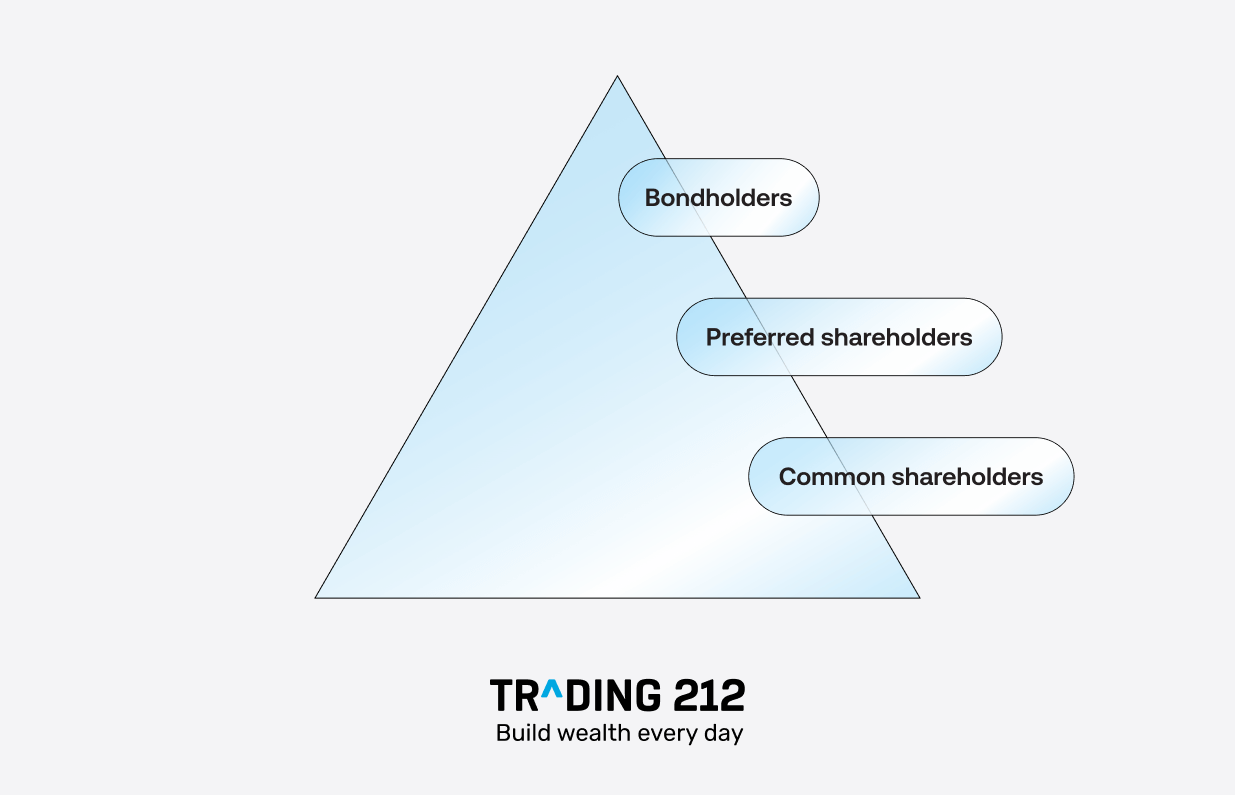
In a liquidation, common stock is paid out last, after preferred stock, bondholders, and creditors. Often when there is a liquidation event or a restructuring due to bankruptcy, the common stockholders receive nothing. Historically, on average, common stock does provide greater returns as compared to preferred stock, even with this increased risk. Please note that past performance isn't indicative of future results. Always do your own research before making investment decisions.
Common stockholders can vote for who directs the company. So while it is the board of directors that takes specific business decisions, such as executive pay, common shareholders can influence those decisions by choosing board members.
Common stockholders can vote for who directs the company. So while it is the board of directors that takes specific business decisions, such as executive pay, common shareholders can influence those decisions by choosing board members.
So the directors should in theory take into consideration the views of the common stockholders when making decisions. Common stockholders can vote on the election of board members, and major corporate actions like mergers, acquisitions, or issuing new shares.
Trading and market presence
Common stocks are actively traded on all the well-known exchanges, so they are more accessible and liquid than preferred shares. Pretty much all news you hear regarding the stock market is in relation to these major common stock shares.
It makes sense, given that the vast majority of shares, particularly for huge tech giants, is issued in common stock. So the next time you hear that GOOGL or AAPL or META declines or increases, you can be sure it refers to common stock. Unless explicitly stated otherwise as a preferred share.
It makes sense, given that the vast majority of shares, particularly for huge tech giants, is issued in common stock. So the next time you hear that GOOGL or AAPL or META declines or increases, you can be sure it refers to common stock. Unless explicitly stated otherwise as a preferred share.
Key differences between preferred and common stock
Ownership structure: Basic vs. preferential rights
A preferred stock can be thought of as a loan, dressed up as equity. Preferred shareholders are the first to claim earnings but usually have no decision making power. They possess debt-like characteristics but remain owners, not creditors.
Recipients of each stock type
The public has full access to common stock. Access is universal. Large financial institutions and hedge funds will more often purchase preferred stocks, sometimes under preferential terms not offered to the wider public.
- | Preferred stock | Common stock |
Voting power | Typically no voting rights | Usually include voting rights |
Dividend structure | Dividends are usually fixed and paid first | Dividends may change or be skipped |
Payment order | Paid before common shareholders | Paid after preferred shareholders |
Volatility | Generally less volatile | Tend to be more volatile |
Growth potential | Lower potential for capital gains | Higher long-term growth potential |
Pricing differences
Preferred shares usually trade at lower prices than the company’s common shares, even though they have a higher claim on income and assets. The main reason is that they lack the growth potential and voting rights that make common stock more valuable to most investors.
Preferred shares behave more like fixed-income securities and are less volatile than common shares. Common shares will rise and fall with basic company headlines, while preferred shares will be more tied in with yields and interest rates. Common stock valuation is a function of what the public believes it to be worth.
Preferred shares behave more like fixed-income securities and are less volatile than common shares. Common shares will rise and fall with basic company headlines, while preferred shares will be more tied in with yields and interest rates. Common stock valuation is a function of what the public believes it to be worth.
Voting rights
Preferred shareholders will almost never have voting rights. Common shareholders will always have voting rights, as this principle lies at the core of the corporate model. If shareholders couldn't vote, they couldn't truly be called owners of the company.
Preferred shareholders have essentially traded decision making potential for a steady income. This is why they can be described almost like lenders as opposed to ownership.
Preferred shareholders have essentially traded decision making potential for a steady income. This is why they can be described almost like lenders as opposed to ownership.
Convertibility
Sometimes preferred shares can be converted to common shares. This allows preferred shareholders to switch sides. This function is known as convertibility.
Investors buy convertible preferred shares for a blend of income and growth potential. They offer:
Investors buy convertible preferred shares for a blend of income and growth potential. They offer:
- Fixed dividends for steady income, like a bond.
- Conversion rights that let holders switch to common shares if the price rises, capturing upside.
- Flexibility, allowing investors to stay defensive or convert later if the company performs well.
Convertible preferred shares basically trade off higher income for flexibility because they usually offer lower yields than regular preferreds, can be called back by the company, and their value depends on both interest rates and the common stock price. They also risk dilution if many investors choose to convert at once.
Liquidity
Common shares are everywhere, available on all exchanges, and frequently traded. Remember the common shares are basically shares, and preferred shares are a rarer and unique class that function more like loans.
In times of financial stress, liquidity can be a huge concern when it comes to preferred shares. You can easily trade a common stock, but markets for preferred shares are less active and could see much wider spreads.
In times of financial stress, liquidity can be a huge concern when it comes to preferred shares. You can easily trade a common stock, but markets for preferred shares are less active and could see much wider spreads.
Liquidation payout
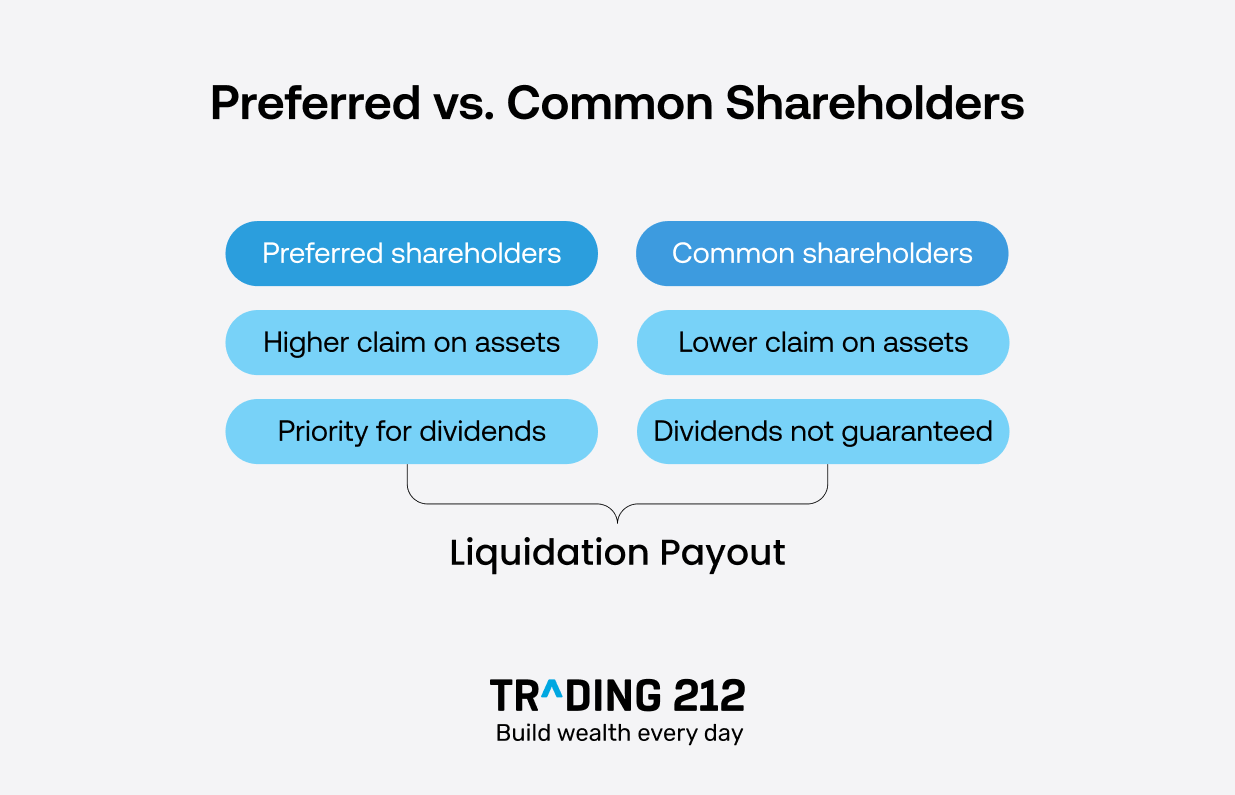
One of the biggest advantages of preferred shares is that they get paid before common shares in case the company needs to be wound up. It is fundamentally why they are safer. However, preferreds are still not bulletproof. Creditors get paid first, then preferred shareholders, and finally common shareholders, though often common shareholders get wiped out in the event of liquidation.
So, while common shares see the biggest upside when times are good, they are last in line when things go south.
So, while common shares see the biggest upside when times are good, they are last in line when things go south.
Risk levels
Common stock offers both higher risk and higher reward. Preferred stock is generally considered safer but with lower rewards stemming from dividends. But bare in mind it is possible to own both common and preferred shares at the same time.
Pros and cons of preferred stock
Advantages of investing in preferred stock
- ✅ Paid steady dividends.
- ✅ Paid before common stockholders in the event of liquidation.
- ✅ Less volatile.
Disadvantages of investing in preferred stock
- ❌ Limited upside.
- ❌ No decision making power (usually).
- ❌ Potentially illiquid and hard to trade.
Pros and cons of common stock
Advantages of investing in common stock
- ✅ Possibility of strong upside.
- ✅ Can vote on company policy and on BOD representatives.
- ✅ Usually liquid (easy to buy and sell).
Disadvantages of investing in common stock
- ❌ Last to get paid in the event of liquidation.
- ❌ May not get paid dividends.
- ❌ More volatility.
Recap
It is essential for any budding shareholder to understand the difference between the two different classes of stock – common and preferred. You should know what kind of asset you hold and what rights you have, as well as its risk/reward profile.
Preferred stock is essentially a form of ownership that functions almost like a loan, with steady dividend returns and less fluctuation.
Common stock is the kind of equity we all know and love. It can go up or down, with massive highs and lows. But the stock market can be brutal. So if you enjoy the highs, make sure you have the stomach to handle the lows.
Preferred stock is essentially a form of ownership that functions almost like a loan, with steady dividend returns and less fluctuation.
Common stock is the kind of equity we all know and love. It can go up or down, with massive highs and lows. But the stock market can be brutal. So if you enjoy the highs, make sure you have the stomach to handle the lows.
FAQ
Q: What is the difference between preferred and common stock?
Common shareholders face the most risk during downturns and are paid last if a company closes. Their payouts aren't guaranteed, and prices can swing with market trends. They may also lose influence when companies issue new shares, reducing their ownership percentage. Returns rely heavily on company performance and broader economic conditions.
Q: Why would an investor buy preferred stock?
Preferred shares appeal to those wanting steady returns with lower volatility. They typically offer fixed payouts and priority over common shares during distributions or liquidation. Investors seeking predictable income may prefer them, especially in low-interest environments, as they provide a balance between the safety of bonds and the upside of equity ownership.
Q: What is an example of preferred stock?
Many large firms issue preferred shares to raise funds while retaining control. For instance, major banks like JPMorgan Chase or Wells Fargo offer preferred shares that provide steady payments to investors. These securities trade separately from the company’s regular shares and often attract income-focused investors seeking reliable, periodic payouts.
Q: Do preferred stocks pay dividends?
Yes, preferred shares generally offer consistent payouts, often at a fixed rate. These payments are made before common shareholders receive any returns. While the company may suspend payouts in difficult times, most preferred shares aim to provide stable, bond-like income for investors, making them attractive for those seeking predictable earnings.
Q: Is Apple a common or preferred stock?
Apple primarily issues common shares, which trade publicly and give investors ownership rights and voting power. The company doesn't currently issue preferred shares. Common shareholders benefit from Apple’s growth through price increases and dividends, but they don't receive the fixed-income benefits typical of preferred securities.
Q: Why might companies not like preferred stock?
Issuing preferred shares can be costly for a company since fixed payouts must be honored even when profits are low. It can also reduce financial flexibility and increase long-term obligations. Unlike regular borrowing, these payments can’t always be skipped without affecting investor trust or the company’s future fundraising ability.
Q: What role can preferred stocks play in retirement?
Preferred shares can offer retirees a reliable income through fixed payments, similar to interest-bearing instruments. They also provide potential price growth, though with less fluctuation than common shares. This blend of stability and moderate potential return makes preferred shares an option for diversifying a retirement portfolio while balancing risk and reward.