Alternative Investment Market (AIM): Investing in small cap shares
The Alternative Investment Market (AIM) is home to some of the UK’s lesser-known, high-potential and high-risk shares, making it a prime hunting ground for the more adventurous investors.
Firms that wish to secure new funding but do not meet the size requirements or want to avoid the strict regulatory burdens of listing on the London Stock Exchange (LSE) often find their way to AIM instead.
Firms that wish to secure new funding but do not meet the size requirements or want to avoid the strict regulatory burdens of listing on the London Stock Exchange (LSE) often find their way to AIM instead.
QUOTE
The stock market is a device for transferring money from the impatient to the patient.
– Warren Buffett
– Warren Buffett
Please note that the information provided in this article applies specifically to the UK market.
Big ideas
- AIM is not related to alternative investments in the sense of alternative assets like antiques or investing in a hedge fund – AIM refers to UK-listed stocks. It is merely a subsection of the London Stock Exchange (LSE), with different requirements for listing.
- AIM is tailored towards smaller, higher risk companies. However, the listing process is still not easy. It requires significant capital and a lot of preparation, such as having three years of financial statements. Listing on AIM is still an IPO.
- Based on data published by the London Stock Exchange, by late 2024 the number of companies listed on AIM had fallen to its lowest level in over two decades. Rising listing and compliance costs, along with uncertainty around future tax incentives, can be seen as contributing factors to this decline.
What is the Alternative Investment Market?
According to the LSE, AIM was launched in 1995 to replace the Unlisted Securities Market and to give smaller companies access to public capital under more flexible rules. It began with just 10 listed companies. Today, AIM includes a notable share of international listings, reflecting its broader reach compared to its early years.
AIM Market Highlights in the UK (2024)
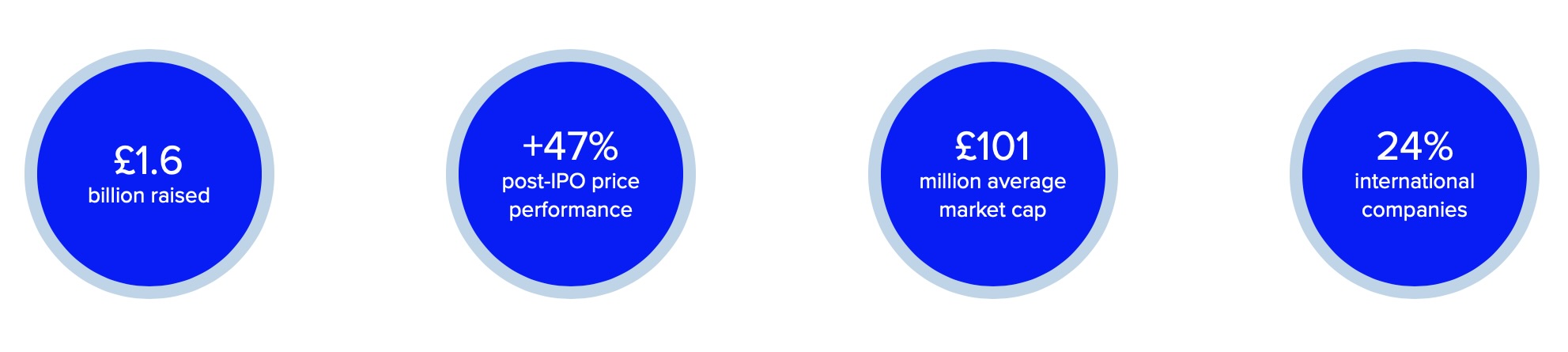 Source: London Stock Exchange
It is even possible to track AIM through indexes such as FTSE AIM UK 50 Index, FTSE AIM 100 Index, and FTSE AIM All-Share Index. Companies that prefer to list on AIM are usually those that have exhausted private funding opportunities but still fall short of an LSE listing.
AIM believes in self-regulation, that is to say AIM is exchange-regulated rather than directly regulated by the Financial Conduct Authority (FCA). As such it escapes many of the mandatory provisions set out by European Directives and implemented by UK authorities. However, critical to its success is the concept of nominated advisers (NOMADs) who are effectively gatekeepers for new entrants to the exchange, providing guidance on the listing process.
AIM believes in self-regulation, that is to say AIM is exchange-regulated rather than directly regulated by the Financial Conduct Authority (FCA). As such it escapes many of the mandatory provisions set out by European Directives and implemented by UK authorities. However, critical to its success is the concept of nominated advisers (NOMADs) who are effectively gatekeepers for new entrants to the exchange, providing guidance on the listing process.
What is the difference between the LSE and AIM?
Though AIM and the main London Stock Exchange (LSE) are both run by the same parent group, they serve very different types of companies. The LSE is home to big, established players. AIM, on the other hand, caters to smaller, growing firms – often earlier in their journey. Here is how they differ across several key areas:
- Number of shares – companies on the LSE usually have a large number of shares on the market because they аre typically much bigger businesses. AIM firms tend to be smaller, so their share volumes reflect that.
- Trading history – LSE applicants usually need to show at least three years of financial track record. AIM skips that requirement entirely. If a company is young but has a solid case, it can still apply.
- Shareholder approval – big moves (like acquisitions or selling off major parts of the business) often require a shareholder vote on the LSE. AIM companies have more freedom to act without going back to their investors every time.
- Admission documents – to list on the LSE, companies must submit a full prospectus. It is reviewed in detail by the FCA, and the process can take time. AIM companies produce what is called an AIM admission document, but this does not go to the FCA. It is reviewed internally by the NOMAD, keeping the process quicker and more flexible.
- Advisers – every company on AIM needs a NOMAD. Their job is to guide the business through the listing process and make sure they are still meeting the rules afterward. LSE companies do not use NOMADs but usually work with a group of professional advisers, such as brokers, lawyers, accountants, to handle compliance.
- Market cap – the LSE is home to companies with large market values (often hundreds of millions or more). AIM listings are typically smaller, with some worth just a few million. That is part of its appeal – it gives earlier-stage companies a place to raise capital.
- Compliance rules – the LSE has strict reporting standards. Companies must stick closely to the UK Corporate Governance Code and disclose information frequently. AIM is more flexible. That said, listed companies still need to report regularly and follow disclosure rules but with fewer obligations overall.
- Tax treatment – the October 2024 Budget introduced some major changes. Up until then, AIM shares could qualify for 100% relief from inheritance tax after two years, thanks to Business Property Relief (BPR). That is changing. From April 6, 2026, AIM shares will only get partial relief. Instead of being fully exempt, they will be taxed at 20% – a reduced rate, but still a shift from the old setup.
How does a company list on the Alternative Investment Market?
Step 1: Appoint a NOMAD
The first step is hiring a NOMAD (a nominated adviser approved by the exchange). Their job is to help the company through the listing and make sure it is a good fit for the market.
Step 2: Build a team
Alongside the NOMAD, the company will usually bring in a broker, legal team, and accountants. Together, they will prepare the AIM admission document. This outlines what the company does, who runs it, how it is financed, and what it is planning. Unlike the LSE’s prospectus, it does not go to the FCA.
Step 3: Show readiness
There are no hard rules about how big or profitable a company must be. Still, it needs to show that it has proper systems in place – solid governance, capable leadership, and a clear plan. It also has to agree to play by AIM’s rules.
Step 4: Go public
The whole process usually takes a few months. Once approved, the company’s shares can be traded on AIM. From that point on, it needs to report its results regularly and keep investors updated on any big developments.
What companies can join the Alternative Investment Market?
AIM is open to a wide range of companies from different industries, sectors and countries but almost all of them are small or medium-sized. Some are early-stage. Others are more developed but want more flexible rules than the main market offers.
EXAMPLE
A standout example in recent memory was ASOS plc.
ASOS remained listed on the AIM market for nearly two decades from its IPO in 2001 until its transfer to the London Stock Exchange's Main Market in February 2022. During that time, it grew into one of the largest AIM-listed companies and, by market cap, was even large enough to qualify for the FTSE 100.
Past performance is no guarantee of future results. This information is not investment advice. Do your own research.
ASOS remained listed on the AIM market for nearly two decades from its IPO in 2001 until its transfer to the London Stock Exchange's Main Market in February 2022. During that time, it grew into one of the largest AIM-listed companies and, by market cap, was even large enough to qualify for the FTSE 100.
Past performance is no guarantee of future results. This information is not investment advice. Do your own research.
Which companies can join AIM?
There are no minimum requirements for size, revenue, or track record. A company does not need to be profitable. It can be based in the UK or abroad. What matters is that it meets AIM’s admission rules and has a nominated adviser.
Many types of companies join AIM – tech firms, biotech startups, mining companies, and others looking for growth capital. Some are family-owned businesses that want outside investment. Others are fast-growing firms backed by private equity.
AIM is often used by companies that want public funding but are not ready or willing to join a heavily regulated exchange. It can also be a step before joining the main London Stock Exchange later on.
Many types of companies join AIM – tech firms, biotech startups, mining companies, and others looking for growth capital. Some are family-owned businesses that want outside investment. Others are fast-growing firms backed by private equity.
AIM is often used by companies that want public funding but are not ready or willing to join a heavily regulated exchange. It can also be a step before joining the main London Stock Exchange later on.
AIM success stories
Several well-known companies started on AIM before growing into major players. The companies are spread across various sectors as opposed to being focused in specific areas. Successful companies include:
- ASOS – previously mentioned, this is an online fashion retailer that joined AIM in 2001 with a market cap under £15 million. It later became one of the UK’s most valuable e-commerce businesses, with a market cap that reached nearly £5 billion.
- Fever-Tree – this enterprise makes premium mixers, listed in 2014. Its strong brand and international growth helped its share price rise quickly.
- Abcam – this is a biotech firm supplying research antibodies, used AIM to fund its expansion and became a leader in its field.
- Jet2 – this is a popular travel and leisure company, which grew significantly after joining AIM.
Other notable AIM-launched firms include Boohoo Group and Hutchmed. These companies used the market to raise funds, build investor confidence, and grow their business over time. Some later moved to the main London Stock Exchange. Their success shows that AIM can work well for businesses with strong models and good management, even if they start small.
Recap
AIM was once seen as one of the most active small-cap markets in the world. Many international companies used it to raise money and increase visibility in the UK. But things have shifted in recent years. Costs have gone up. Regulation has tightened. Also, changes in tax policy could reduce some of the past benefits, like inheritance tax relief.
Still, AIM remains important for certain types of companies. The listing process is flexible and there is no minimum size or trading history required. For investors seeking a high potential company and are prepared to do some research, it might be a good place to start.
Still, AIM remains important for certain types of companies. The listing process is flexible and there is no minimum size or trading history required. For investors seeking a high potential company and are prepared to do some research, it might be a good place to start.
FAQ
Q: How do I invest in an AIM-listed company?
You can invest in AIM-listed companies through a stockbroker or an online trading platform. Just open an account, search for the company, and place a buy order. Make sure the platform gives access to AIM shares, as not all of them do.
Q: What benefits does AIM offer to investors?
AIM offers access to smaller, fast-growing, or niche companies that are not found on the main exchange. It has produced success stories, but not every company performs well. The market has become smaller and more selective, but it still offers something different from the main market, especially for investors willing to look past the big names and dig into smaller ones.
Q: What are the challenges of AIM investment?
Liquidity can be a challenge. Not all AIM stocks trade frequently. Prices may move sharply on small volumes. This makes it harder for big institutions to enter or exit positions. On the other hand, this can create chances for retail investors who are willing to spend time looking at under-followed names.
Q: What are the cost and time requirements of listing on AIM?
Cost and time requirements can vary. While the listing process can be completed within 10 to 12 weeks, the preparation time can run as long as two years or more. In terms of costs, they can easily exceed £500,000, with a £100,000 annual maintenance cost.
Q: What is an example of an alternative investment?
An example of an alternative investment is real estate. Unlike traditional stocks and bonds, real estate investments involve purchasing property to generate rental income or capital appreciation. Other examples include private equity, hedge funds, commodities, and collectibles like art or vintage cars.